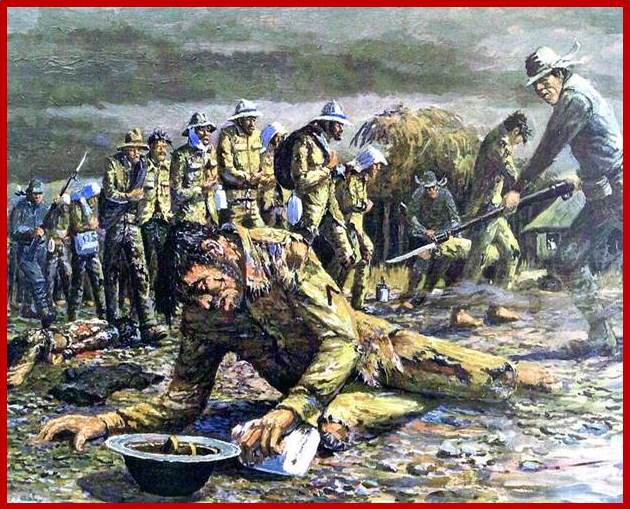
With Easter approaching and its focus on the Via Dolorosa, it’s fitting to revisit one of the Philippines’ most harrowing historical tragedies: the Bataan Death March.
There have been many death marches throughout history – grim journeys in which prisoners of war or detainees are forced onward under brutal physical strain, beatings, medical neglect, humiliation, and, above all, the immediate execution of anyone who falters. The march may end at a prison camp – or it may continue until no one is left standing.
When the Defense Collapses
World War II came to the Philippines much as it had Hawaii, Hong Kong, and the Malay Peninsula – on December 7, 1941. Barely ten hours after the attack on Pearl Harbor, Japanese bombers appeared over Clark Field, a military airbase north of Manila.
Despite receiving advance warning, American forces were still caught off guard. Within minutes, much of the U.S. Army Air Forces assigned to defend the Philippines was destroyed on the runways.
On December 22, Japanese troops landed in Lingayen Gulf and began their rapid conquest of Luzon. In the months that followed, the situation for the American-Filipino USAFFE forces (United States Armed Forces in the Far East) went from bad to hopeless.
With both the U.S. Air Force and Navy effectively wiped out in the region, General MacArthur was forced to fall back on War Plan Orange-3 – a defensive strategy drafted in 1904 during the Russo-Japanese War.
The plan was straightforward: defend Luzon as long as possible, then retreat to the Bataan Peninsula and hold out for at least six months while awaiting reinforcements from Hawaii. There was, however, a major problem. The Americans had recently lost eight battleships at Pearl Harbor – four of which were supposed to come to Bataan’s rescue with supplies and reinforcements.
A Change in Command
The better-equipped and better-led Imperial Japanese Army quickly overpowered USAFFE forces, pushing them to the Bataan Peninsula and the fortified island of Corregidor. Instead of withdrawing immediately to Bataan – where defenses and supplies had been staged – the defenders delayed, exhausting most of their food and ammunition before they even reached Bataan.
By late March, daily rations for USAFFE soldiers had dropped to around 800 calories – and even that was considered a luxury. Malnutrition had already taken hold before the main fighting even began.
From the outset, it was clear that the promised reinforcements were not coming. The Allies were losing ground across Southeast Asia and had no spare resources for the Philippines. Still, MacArthur reassured his troops that help from Hawaii was on the way.
Meanwhile, as underfed and ill-equipped troops fought the Japanese while also battling dysentery and starvation on Bataan, MacArthur – now safely on Corregidor – asked President Quezon to appoint him Field Marshal of the Philippines, complete along full salary and benefits to be paid in advance (around $500,000).
Despite everything, the combined American and Filipino forces held out until April 9. By then, starving and sick soldiers had no choice but to surrender. The fall of Bataan marked the largest military defeat in U.S. history up to that point.
On March 12, MacArthur and Quezon had already “relocated” to Australia, leaving General Jonathan Wainwright to handle the defense of Corregidor. As he departed, MacArthur delivered his famous line: “I shall return.”
He eventually did, just not in time to help the men he left behind. Corregidor fell in May, and the Philippines came under full Japanese occupation.
The Nightmare Begins
After the surrender of Bataan, the Japanese planned to move the captured American and Filipino soldiers – about 65 miles (105 kilometers) – to a rail station in San Fernando, from where they would be transported to prison camps.
There was one major complication: they had around 76,000 prisoners – nearly double what they had expected. Many were already sick or wounded. The Japanese themselves were short on food, water, medicine, and transport. With vehicles tied up in preparations for the assault on Corregidor, they chose the simplest solution: march the prisoners to San Fernando in five to six days.
The march began on April 10 from Mariveles, where thousands of prisoners had been left waiting in the open for food and medical care that never came. They were assembled into long columns and ordered to move. Anyone who refused was shot on the spot.
Additional prisoners joined the march from other parts of Bataan, forming a ragged column stretching for miles – a long, grueling march of exhausted men heading north.
The Beast Within
The prisoners’ suffering was compounded by one crucial detail: the Japanese did not recognize them as prisoners of war. The Imperial Army followed the Bushido code, which viewed surrender as the ultimate disgrace. Soldiers were expected to die – or even commit suicide – rather than be captured. To them, anyone who surrendered was a coward and a traitor, unworthy of humane treatment.
Add to that the resentment of Japanese soldiers who had themselves endured months of brutal fighting, and the result was predictable – cruelty was given free rein. Food and water were scarce. Many died of thirst or starvation. A common form of torture was the so-called “sun treatment,” where prisoners were forced to march under the blazing heat without helmets or head coverings. Asking for water could get a prisoner shot.
Some prisoners were stripped naked or forced to walk past fresh water they were forbidden to drink. Trucks ran over the fallen. “Cleanup crews” executed those too weak to continue. Prisoners were stabbed with bayonets, beaten to death, or shot for stopping – even to relieve themselves or because of illness.
Diseases spread rapidly due to poor hygiene. Desperate men drank from muddy puddles, roadside ditches, or animal troughs. There was no medical care. Allied medics did what they could without supplies, tools, or medicine.
Worse Than Death
When the prisoners reached San Fernando, they were crammed into metal boxcars – about 100 men per car – in oven-like conditions. There was no room to sit, barely room to breathe. Hundreds died during the hour-long journey.
From there, survivors traveled to Capas and then marched another 9 miles (14 kilometers) to Camp O’Donnell, a former Philippine military base turned prison camp. Of the roughly 76,000 who began the march, only about 54,000 made it to the camp. The suffering, however, was not over.
If a prisoner was too weak to work, he went hungry. No work meant no food – which for the sick and wounded was a death sentence. All outside aid, including Red Cross shipments, was refused. The camp’s staple food was lugaw – a watery rice porridge that might include fish heads, rats, vegetables, or whatever insects ended up in the pot.
The camp hospital earned the nickname “Zero Ward” – a place you were sent to die. There were no medicines, no equipment, no real care. Camp O’Donnell soon became known as “Camp O’Death,” where hundreds died daily from starvation and disease. Bodies were buried in mass graves beyond the barbed wire.
The perimeter was little more than flimsy strands of barbed wire, so escape was theoretically possible. But where would anyone go? The nearest safe territory was over 1,800 miles (3,000 kilometers) away in Australia. To discourage escape attempts, the Japanese implemented a system: prisoners were organized into groups of ten. If one man escaped, the other nine were executed.
American prisoners did not speak the local languages and had no local support. Many locals collaborated with the occupiers, ready to turn in escapees for a reward. And then there was the obvious problem: you can’t change the color of your skin. A white prisoner stood out like a prison uniform you couldn’t remove.
Evil Meets Its End
Months later, prisoners began to be transferred from Camp O’Donnell to other camps with somewhat better conditions. Many American prisoners ended up at the Cabanatuan camp complex. On January 30, 1945, U.S. and Filipino forces liberated Cabanatuan camp and freed the remaining prisoners.
After Japan’s surrender in September 1945, General Masaharu Homma – the commander responsible for the march – was arrested and tried by a U.S. military commission for war crimes.
His defense? He claimed he had been too busy planning the assault on Corregidor to pay attention to the prisoners – and assumed his officers were handling things humanely. He also stated that he only learned about the atrocities after the war.
It was a desperate defense: claiming a lack of oversight in a case where that very negligence was the core of the crime. On February 11, 1946, Homma was found guilty and sentenced to death by firing squad – a more “honorable” execution than hanging, at least by the standards of the time.
The sentence was upheld, and he was executed on April 3, 1946. This may seem like a neat ending. But for tens of thousands who marched, suffered, and died, justice came too late – if it came at all.
