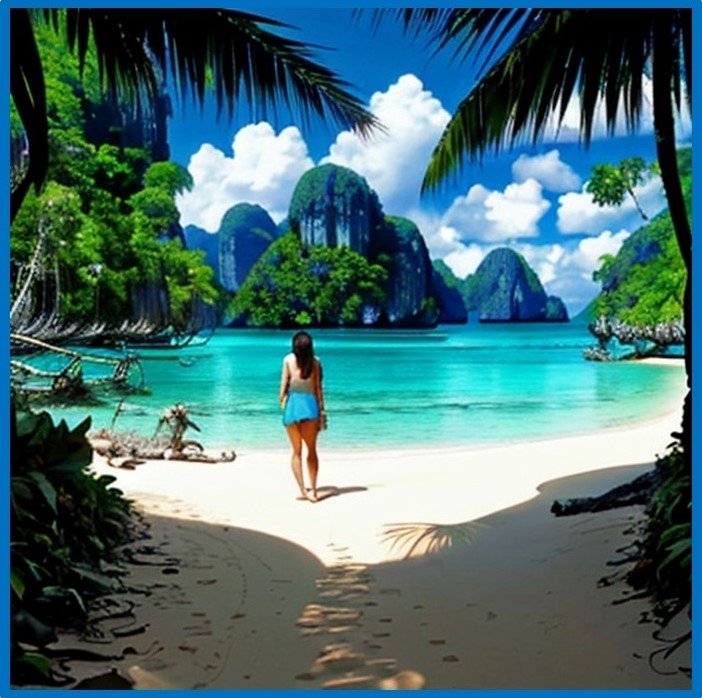
Everyone, at some point, experiences a moment that feels almost magical – when a dream suddenly seems real. It may last only a split second, but it stays with you forever. I had mine on an island cloaked in emerald rainforest, when I slipped into a turquoise sea and found myself surrounded by the dazzling colors of coral reefs.
Contrary to accepted scientific theory, the Big Bang didn’t happen 13 billion years ago. It happened in the early 1990s; the first time I saw the islands of Palawan through an airplane window. The moment I set foot there, my personal universe began expanding at an accelerating pace.
Maybe it was the limestone cliffs, the empty white-sand beaches, the hypnotic beauty of lagoons and scattered islands. Maybe it was a new love at my side, or life experiences that suddenly had the perfect backdrop. Whatever the reason, I’m grateful that, at that moment, I was exactly where I was meant to be.
It was a time when the archipelago’s best-known destinations – El Nido, Port Barton, Sabang, and Busuanga – were most commonly accessed by boat. Scenes straight out of Indiana Jones and Tarzan stopped being fiction and became part of everyday life. In that world, I learned the language, the customs, and the basic rules of life in the Philippines.
Palawan became my home for most of the 1990s, and it has remained a significant part of my life ever since. The islands of the province have been praised in countless travelogues and blogs, and in this article, I will share my own affection for this unique archipelago.
A Return to the Past
While the rest of the world was busy riding the early wave of mobile phone mania, I was learning how to live among indigenous communities and on remote islands. Around that time, backpackers and adventure travelers began discovering Palawan, and for a freshly graduated geographer, it offered a chance to make a living doing things that didn’t feel like work in the slightest.
I found myself mapping and exploring even the smallest reefs and islands in the archipelago – a pursuit that ultimately captured my heart and overruled my better judgment. Along the way came work assisting film crews and journalists, guiding expeditions, leading motorcycle safaris, and embracing all sorts of experiences perfectly suited to a young, unattached man who believed this was exactly how life was meant to be lived.
It was exhilarating to be part of the momentum as Palawan evolved from a well-kept secret among a handful of backpackers into a leading destination in Philippine tourism. In the provincial capital of Puerto Princesa, I built my own oasis – Banwa Pension and Art House – which served as my base in Palawan for nearly two decades, until a fire reduced it to a memory in 2014.
Around the turn of the millennium, the first signs of adulthood – and a growing fatigue with a life of constant adventure – pulled me to Manila and back onto the same timeline as the rest of the world. Still, I never quite managed to break away from Palawan. I kept the relationship alive with monthly visits… until the pandemic temporarily drove us apart.
Now we’re reunited again, and I get to enjoy the stripped-down simplicity of my jungle office and the bright light of Palawan’s morning sun – the same light that sparked that personal Big Bang and fused me permanently to this place.
The Sweet Queen of the Sulu Sea
The respected New York–based travel magazine Travel + Leisure has consistently ranked Palawan among the world’s most beautiful islands since 2013, based on traveler experiences. In recent years, readers of Condé Nast Traveler have also voted it one of the top destinations in Asia.
Like it or not, Palawan is on an inevitable path toward mass tourism. As its long-slumbering tropical paradises are fully established in the global travel scene, Bali may lose its status as the ultimate tropical paradise.
It’s worth noting the following places: San Vicente, Port Barton, Coron, Balabac, Cuyo, Linapacan, Culion, and the Underground River (a UNESCO World Heritage Site). Some of these places are already familiar to travelers in the Philippines, while others are still quietly maturing in relative isolation.
With mass tourism comes an unavoidable contradiction: how do you balance pristine, untouched nature with the growing crowds eager to experience it? Beyond its pleasant climate, Palawan’s greatest asset is its raw, unspoiled beauty. In a wealthy and densely populated Asia, that kind of authenticity has become increasingly valuable – immune to inflation but easily devalued by overuse.
The Crown Jewels
Because my relationship with Palawan is deeply personal, I’m probably the last person who should be giving practical advice about its tourist attractions, good or bad hotels, restaurants, or any of the ever-changing basics of travel. When nearly every village and island trigger memories of adventures, stories, and moods, those experiences blur my perspective to the point where recommendations start to feel irrelevant – at worst, even misleading.
Overall, Palawan is the most versatile travel destination in the Philippines. It offers the full spectrum – from humble backpacker guesthouses to some of the country’s most luxurious resorts. On top of that, the archipelago is home to two truly unique, world-class diving destinations: the Tubbataha Reefs in the Sulu Sea and the Japanese shipwrecks off the coast of Busuanga Island.
The Tubbataha coral reef system is a protected and closely monitored marine area, accessible only through pre-booked 5–6-day liveaboard diving trips. These expeditions depart from Puerto Princesa between late March and the end of June, when the seas are calmest and underwater visibility is at its best. The legendary diving pioneer Jacques Cousteau – recognizable in his red beanie – once described Tubbataha as “the most beautiful place I have ever explored.”
In northern Palawan, the island of Busuanga offers a distinctive wreck-diving experience. During World War II, American torpedo bombers sank seven Japanese warships and cargo vessels off its coast. Two of the wrecks lie close enough to be explored by snorkelers, while the rest lie at depths of 20 to 30 meters. More experienced divers can obtain special permits to explore the interiors of the wrecks – and fully experience the unique thrill of claustrophobia.
The Ferryman of a Deserted Island
As in life, first loves tend to linger – and set the standard for everything that follows. That’s exactly what happened to me. In Palawan, I felt at home almost instantly. Add a love story to the mix, along with all the open horizons that come with youth, and that first encounter left a mark I’ve never quite shaken off – nor do I want to.
That kind of enchantment rarely comes from the place itself. It’s born from moments, circumstances, and moods – and from the chemistry between your expectations and the local reality. That’s the potion that keeps the spell alive, bringing the original magic back to life again and again.
In Palawan’s case, I believe the setting itself played an unusually large role in why it still holds such a strong place in my life. The archipelago’s white-sand beaches, jagged limestone landscapes, deep-blue lagoons, vibrant marine life, lush rainforests, and picture-perfect tropical islands are a constant reminder of how beautiful life can be.
In Palawan, the gap between dreams and reality was, for me, as small as it gets. The years I spent there also reshaped my understanding of purpose, meaning, and happiness. They proved, more convincingly than anything else, how little we actually need to feel content – as long as you are moving in sync with the life around you and the one within you.
Requiem for a Dream
Shortly before the pandemic, I met two young women in Puerto Princesa. They were standing at the counter of a bamboo bar, scrolling through photos on their phones, selecting the ones worth posting on social media. Hearing them speak Finnish caught my attention, so I introduced myself, and soon we were reviewing their pictures together.
I told them stories about the places in their photos and gave them tips on other photogenic spots. In return, they helped build a bridge for me – connecting my longing for distant horizons and deserted-island fantasies with the mindset of a new generation.
They explained that they had escaped the Western way of life for the paradise beaches of Southeast Asia. They were chasing unique experiences – that, over time, become shared touchstones for an entire generation.
In their view, Palawan is the perfect destination because it delivers the ultimate paradise-beach selfie. That, for them, is the ultimate measure of a good travel destination. The only rule? No other people in the background. Their presence would make the image feel less authentic – the illusion that only the photographer has discovered paradise. If others appear in the frame, it proves they’ve found it too – paradise lost.
There’s something oddly familiar about the act of taking a selfie on isolated paradise beaches. It’s reminiscent of how early explorers drew maps to claim and confirm new lands. A place became real only after it was charted. Today, the same thing happens through selfies. Nothing quite feels real unless it’s shared on social media.
And yet, for the person taking it, a selfie is also a brief fulfillment of longing – a snapshot of a dream that, for a brief moment, becomes real.
More on the topic:
The Philippines as a Tourist Destination (part 1)
