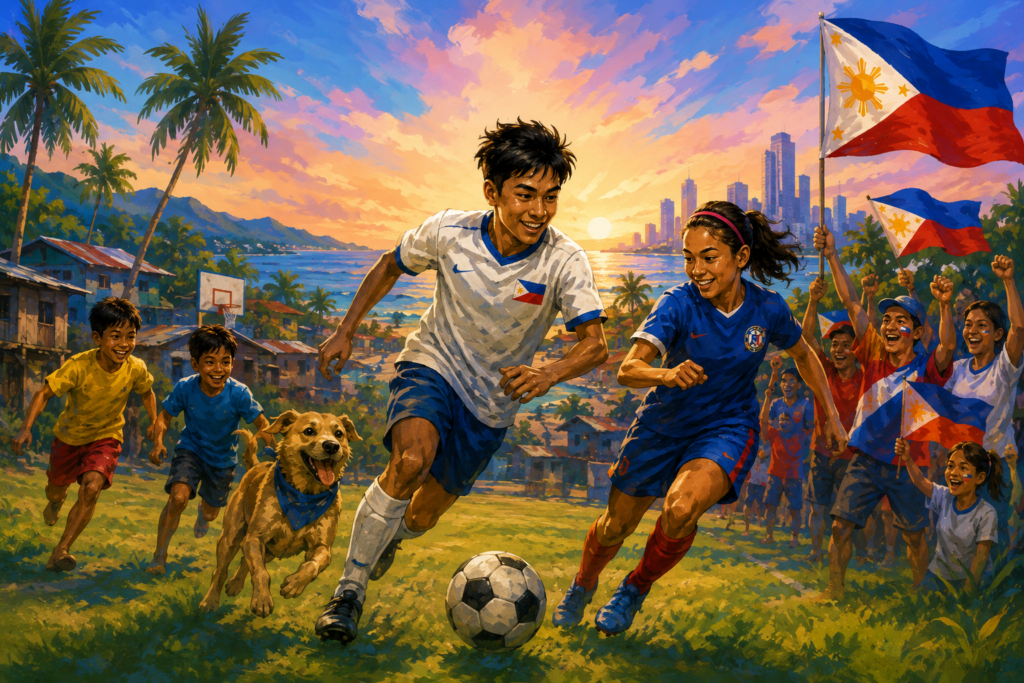
Whenever nations face off in major football tournaments, people across the globe glue themselves to their television screens. Well, not quite everywhere. In the Philippines, for historical reasons, football has never exactly set the national soul on fire.
Those students kicking a leather ball between two posts on the foggy school grounds of 19th-century England could never have imagined that the sport they invented would become one of the great missed opportunities in the sporting history of a distant Pacific island nation.
Football could have become the national obsession of the Philippines too – just like in Latin America, where the game spread through British workers, merchants, and sailors. But then the Americans showed up and ruined everything.
If a traveler in the Philippines goes searching for the kind of football fever found in Europe or South America, they may be in for a surprise. One rarely sees children playing football in the streets, the World Cup does not bring the entire nation to a halt, and local bars are not filled with men arguing about formations and tactics as if civilization itself depended on a proper 4-3-3.
Instead, nearly every village has a basketball court – often crooked, cracked, rusted, and held together by tropical humidity and pure delusion. The rims lean sideways, the concrete is uneven, and most players are too short to dunk, yet the atmosphere feels like Game 7 of the NBA Finals.
Had football conquered the country the way basketball did, the Philippines might today be a serious Asian football nation, since height matters far less in football than it does in basketball. But no – from the very beginning, Philippine sports somehow turned the entire opportunity into an own goal.
From Offside to Extra Time
Even though football spent decades living in basketball’s shadow, the sport never completely disappeared from the Philippines. Its history is filled with small revivals, ambitious projects, and repeated attempts to build a genuine football culture in the archipelago.
Here are some of the turning points and memorable moments in Philippine football history:
- Football was introduced to the Philippines by British sailors and immigrants. The country’s oldest club, Manila Sporting Club, was founded in 1906.
- In 1907, the Philippine Amateur Football Association was established – today known as the Philippine Football Federation – making it one of the oldest football federations in Asia.
- Football’s hopes of becoming the country’s dominant sport received the kiss of death in 1910, when the American colonial administration officially introduced basketball into the school system.
- Philippine-born Manuel Amechazurra, whose parents were both Spanish, became one of the first players of Asian background to play for a major European club. He played around 200 matches for FC Barcelona, captained the team, and became one of its early key players.
- Paulino Alcántara followed in his countryman’s footsteps as the second Asian-born player at a major European club. He debuted as a striker for FC Barcelona in 1912 at just 15 years old. Alcántara later became a club legend and remains one of Barcelona’s greatest scorers, second only to Lionel Messi.
- The Philippine national team played its first international matches at the 1913 Far Eastern Championship Games, facing China (0–2) and Japan (1–0). China won the tournament, but the victory over Japan became the first official win in Philippine national team history.
- A national football championship league featuring eight teams began in 1921.
- By the 1950s, football remained largely confined to elite universities, where teams gathered once a year to decide the national champion.
- In the early 1960s, the Philippine Football Federation partnered with San Miguel Brewery to develop the sport and hired English coaches Alan Rogers and Brian Birch to train referees, coaches, and players.
- In 2008, the Filipino Premier League was launched with eight teams from the Manila metropolitan area. The first – and ultimately only – champion was the Philippine Army’s team. The league collapsed after just one season.
- The following year, the United Football League (UFL) was formed and served as the country’s top league until 2017, when the Philippine Football League became the nation’s premier professional football competition.
Azkals – Stray Dogs Chasing the Ball
The Philippine men’s national team was once nicknamed the “Tri-Stars,” referring to the three stars on the Philippine flag. The name never really caught on.
Starting in the mid-2000s, the team became widely known as the “Azkals,” a slang term derived from “askal,” meaning stray dog. The Philippine Football Federation officially retired the nickname in 2024, although many Filipinos still commonly use it.
- The national team is managed by the Philippine Football Federation and has competed internationally since 1913.
- In 1917, the team recorded one of the most absurd scores in Asian football history at the Far Eastern Championship Games in Tokyo, demolishing host nation Japan 15–2.
- The Philippines suffered its heaviest defeat during qualification for the 1968 Summer Olympics, losing 15–0 to Japan.
- In 1991, the Philippines finished fourth at the Southeast Asian Games – still the country’s best result in the tournament.
- In September 2006, the Philippines fell to 195th place in the FIFA world rankings, its lowest ranking ever.
- In 2009, the federation launched “Project 100,” an ambitious plan to push the national team into FIFA’s top 100 by recruiting overseas-born Filipinos to play for the country.
- In May 2018, the Philippines reached 111th place in the FIFA rankings – the highest position in its history. As of May 2026, the team is ranked 135th.
- The national team has been coached by a colorful parade of foreign managers: Americans, Argentines, Englishmen, Germans, Scots, Spaniards, and even – at one point – a Swede, because apparently no football rebuilding project is complete without at least one Scandinavian quietly looking disappointed on the sidelines.
- The current head coach is Spanish manager Carles Cuadrat, who first joined as an assistant coach before eventually becoming the permanent head coach.
Malditas – The Feisty Women with Claws
The Philippines also has a women’s national football team that competes internationally, although success has historically been limited due to the difficulty of finding experienced players.
- In 1980, Cristina Ramos founded the Philippine Ladies’ Football Association, which led to the formation of the first women’s national team.
- The team played its first matches at the 1981 AFC Women’s Championship, now known as the AFC Women’s Asian Cup.
- Their first home matches were played at the Iloilo Sports Complex when the Philippines hosted the 1999 AFC Women’s Asian Cup.
- The women’s team became known as “Malditas” around the time of the 2005 Southeast Asian Games. In Tagalog, the term roughly means feisty and strong-willed women.
- Although the players themselves wanted to keep the nickname, some critics considered it offensive toward women, and in March 2022 the team was officially renamed “Filipinas.”
- From December 2023 to March 2024, the team reached 38th place in the FIFA women’s rankings – the highest ranking in its history.
- On July 25, 2023, the Philippines defeated New Zealand 1–0, earning its first-ever victory at the FIFA Women’s World Cup. Despite the historic win, the team failed to advance from the group stage.
- Younger players, however, hint at a brighter future. In July 2024, teams from Makati Football Club won gold medals in the girls’ under-11 and under-12 divisions at the Helsinki Cup, while also taking silver in the 13/14 division.
The Citizenship Bench
Although the Philippines has mostly stayed away from the moral grandstanding and political theater of international sports boycotts, its football history has not been entirely free of controversy.
The biggest debate surrounding Philippine football has often centered on who should qualify as “Filipino”. Both the men’s and women’s national teams have faced criticism because many of their players were born and raised abroad, hold dual citizenship, and often have only one Filipino parent.
And while the Philippines is unlikely to become an Asian football superpower anytime soon, travelers should still consider watching a local match if the opportunity arises. The atmosphere is relaxed, the tickets are cheap, and within minutes you can see an entire country slowly trying to teach itself how to love the world’s most popular sport – in its own slightly chaotic, deeply lovable way.
