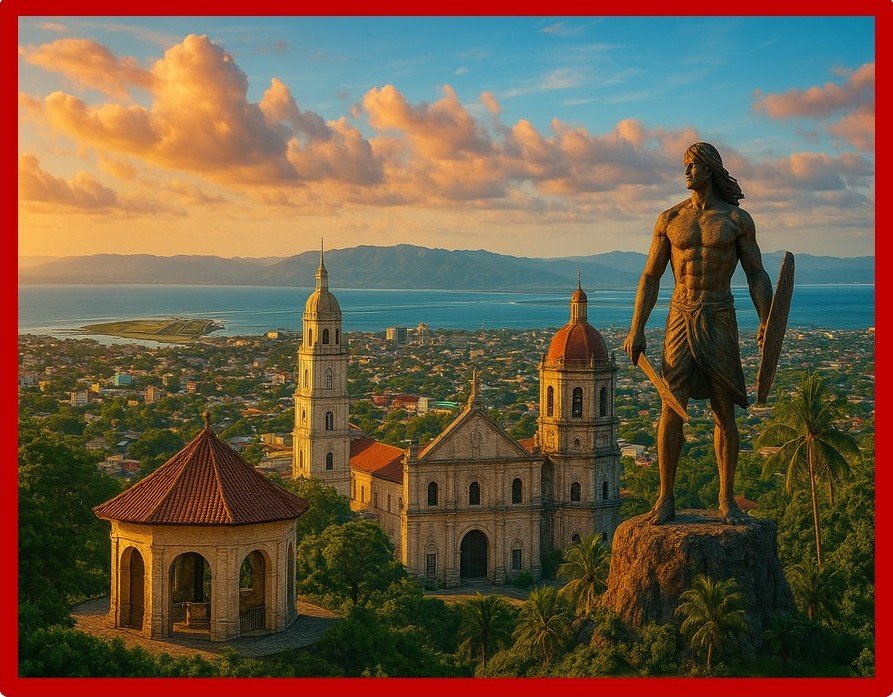
If Metro Manila is the brain of the Philippines, then Cebu City is its heart – and the heart, as we know, sometimes does things the brain simply cannot explain. It beats, dances, loves, and sings. You can only find its rhythm when you stop searching and simply let yourself be.
I have a problem with Cebu City. Not a serious one – not the kind that would make me swear never to return – more like being slightly out of tune with the place, something that keeps me from falling completely head over heels for it. And yet, walking its streets, you can always feel that something genuine is present.
Cebu City, nicknamed the Queen of the South, is one of the Philippines’ most well-known and vibrant cities – dynamic, energetic, and in a state of constant reinvention. I know its streets, its landmarks, its people. But somehow it stays slightly beyond my reach, like a familiar neighbor you chat with about the weather but never about anything that matters.
Maybe that’s exactly the problem. I’ve learned to love the extremes – Manila’s magnificent chaos and the deep silence of the smallest islands. Cebu City is too organized to be wild and too chaotic to be peaceful.
It is also a deeply Visayan city. It speaks its own language, lives by its own customs, keeps its own beat. My Cebuano is limited, and I don’t feel at home in its cultural setting the same way I do in the Tagalog-speaking north. It’s a bit like how some people feel more at ease on one coast than the other – not better, not worse, just different.
An Old Soul with a New Pulse
According to the most recent census, Cebu City has roughly one million residents, with the broader Metro Cebu metropolitan area home to over 3.3 million. It is the Philippines’ sixth most populous city and the economic and administrative center of the country’s central and southern regions. It is also where Philippine written history begins.
The Spanish arrived in the 16th century, bringing with them a new God, cathedrals, and Magellan’s Cross – a reminder of conquest and a religion that gradually absorbed local traditions into Christian rituals. The locals didn’t simply receive faith; they reshaped it into something of their own. Prayers, processions, and fiestas took on their own rhythms, colors, and textures.
The Americans arrived at the turn of the 20th century, bringing formal education, English, and modern infrastructure – along with rules, standards, and a certain institutional formality. Schoolchildren learned to read and count in English, but at home they danced and sang in Cebuano.
The Japanese occupation during World War II brought fear and uncertainty, and the city learned to adapt to impossible circumstances. That survival instinct is still deep in Cebu’s DNA – visible in everyday life and in smiles that hold even through the worst typhoon.
Cebu City carries its past lightly and on its own terms. Its people know their history but don’t live trapped inside it – they live alongside it. This layering makes Cebu both enchanting and contradictory. The contrast is disorienting, but also magnetic: nothing is perfect, but everything is real.
The Future Breathes the Past
If Manila has long served as a transit point for travelers heading elsewhere in the country, Cebu City has now taken on that same role, thanks to its international airport, located on a nearby island just across a short strait (on Mactan Island). For many foreign visitors, it is the gateway to the Philippines – the first stop where adventures begin and where dreams either take shape or quietly fall apart.
At the heart of Cebu City stands the Basilica del Santo Niño, a church whose courtyard is always full of people praying, touching the saint’s statue, lighting candles, and taking selfies. It is a union of the sacred and the everyday – where you can just as easily pray for reliable Wi-Fi as for a raise. Here, faith isn’t reserved for the afterlife; it’s a practical tool for getting through this one.
The city’s history hasn’t been locked away in museums – it lives in the streets. Ancient stone churches stand as silent witnesses while shopping malls, banks, and Starbucks locations rise up around them. Magellan’s Cross is still there, but vendors sell mangoes and plastic rosaries in its shadow. The sacred hasn’t disappeared – it’s simply taken on a more commercial form.
The Sinulog Festival, Cebu’s greatest pride, is the perfect expression of all this. Once a year, the entire city erupts into color, drumbeats, and dancing – a fusion of Catholic devotion and full-throttle carnival. Streets fill with dancers waving images of the Santo Niño above their heads. God, music, and the rhythm of the crowd merge into a current that nothing can stop. That is Cebu’s soul – devout and reckless at the same time.
A View into the Heart
One afternoon, when the heat had become too much and the traffic felt like it would never end, I decided to head up into the hills. There are moments in Cebu when the city’s pulse stops feeling like vitality and starts feeling like noise – the kind that drowns out all thought. I grabbed a cab and made my way toward Barangay Busay, the part of the city that climbs into the mountains, where life moves at a different pace.
The drive upward was like a slow transition into another world. Concrete gave way to banana trees, exhaust gave way to wind, and noise gave way to something close to silence. With each switchback, the view opened further: first rooftops, then the whole city, and finally the sea, glittering in the afternoon light like an enormous pool of liquid silver.
As the sun began to set, the city turned into a sea of light. Down there, where just an hour earlier I had been standing in traffic, people were easing into their evenings: children playing in the streets, mothers cooking dinner, jeepneys tracing their endless routes. From up here, the chaos looked like order.
Sitting there, it struck me that maybe Cebu was never meant to be understood through reason alone. It’s like a person who tells their story in several voices at once – sometimes too loud, sometimes barely a whisper, but always without pretense. The city doesn’t try to impress you. It doesn’t make a strong first impression, but it stays with you in ways you can’t quite explain.
And when you watch it from the hills at night, you can see its heartbeat – endless streams of light flowing up the mountainsides and down toward the harbor. It’s a reminder that the city never stops. It just changes tempo, the way a heart does.
All Things Pass – There Is Only Now
Even though Cebu City is the country’s oldest city, it behaves like someone young who refuses to grow up. It may not be a lovable city in the conventional sense. But it is a city without which the Philippines would be incomplete.
I began to understand why Cebu City had never fully opened up to me before. I had been looking in the wrong places – monuments, landmarks, restaurants. The city’s real pull lies in its continuity; in the way it breathes in sync with its own history. Everything flows, everything changes, but nothing truly disappears.
Perhaps that is Cebu’s real nature – a crossroads, not a destination. In the Philippines, everything has passed through it one way or another: culture, religion, customs, traditions. Even if the city doesn’t stir grand emotions in everyone who visits, it teaches something deeper: not every place needs to be the kind that sweeps you off your feet. Some places simply exist – and that is enough.
