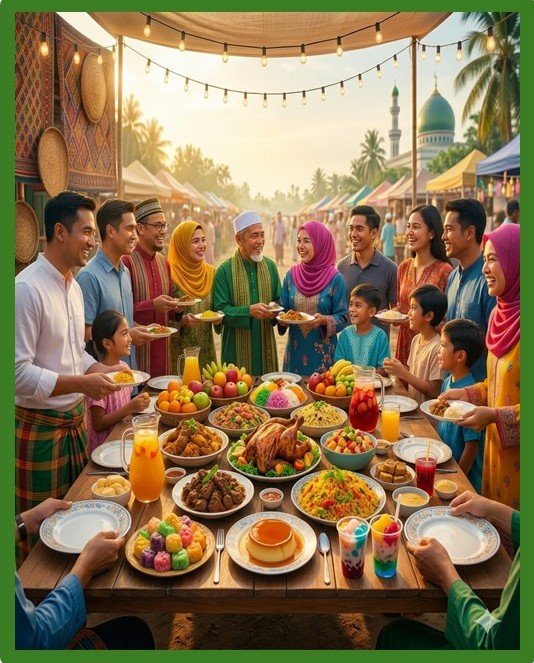
Today in the Philippines, people are celebrating with food and drink in earnest. Some are simply celebrating a welcome day off, while the country’s Muslim community marks the end of Ramadan. Both are perfectly valid excuses to celebrate; they also serve as a reminder that the Philippines has a significant Muslim minority.
Eid al-Fitr marks the end of the fasting month and is one of the country’s two Islamic national holidays. The other is Eid al-Adha, the Feast of Sacrifice, which falls approximately 70 days after Eid al-Fitr.
Eid al-Adha commemorates Abraham’s willingness to sacrifice his son Ishmael in obedience to God. It also coincides with the end of the Hajj, the pilgrimage to Mecca, which gives you a slightly less intense reason to celebrate if the first one feels a bit heavy.
But today, the entire country pauses for Eid al-Fitr, declared a national holiday in 2002 by President Gloria Macapagal-Arroyo as a gesture recognizing the nation’s Islamic heritage.
Eid al-Adha and Eid al-Fitr may be relatively new additions to the Philippine holiday calendar, but they signal something deeper: the country’s Muslim minority is increasingly being heard through political channels rather than armed conflict.
Come One, Come All – Let’s Celebrate
On Eid al-Fitr, Muslims begin with ritual cleansing practices, dress in their finest, often brand-new clothes, and head to communal gatherings, typically at the mosque, to give thanks to Allah for the strength to endure a month of personal sacrifice.
Throughout the day, food and monetary donations – zakat al-fitr – are distributed to those in need and to charitable causes. After shared prayers, the celebration continues in a warm, family-centered atmosphere among relatives and friends.
Muslims make up about 6 percent of the Philippine population and represent the country’s fastest-growing religious and cultural group. Ethnically, they are not markedly different from other Filipinos, yet they have maintained a certain distance from the dominant national culture.
Most Filipino Muslims follow Sunni Islam, though their beliefs often carry traces of older, indigenous island traditions – such as offerings to various spirits that stubbornly continue to persist in local religious practice.
Sultan Goes to Market
In the Philippines, Muslims are commonly referred to as Moros. The term originally came from the Spanish, who used “Moro” for the Muslim Moors of North Africa, their long-time adversaries. When the Spanish encountered Muslims in the Philippines, they recycled the label. It wasn’t until the 1970s that Filipino Muslims themselves adopted the term as part of their cultural and religious identity.
By the time the Spanish arrived in 1521, Islam had already spread across the archipelago, reaching as far north as Manila. Spanish attempts to subdue the local sultanates led to conflicts that, in one form or another, echo into the present day.
Filipino Muslims are fiercely proud of their identity. They are not a single, unified group but consist of at least thirteen subgroups, each with its own language, leadership structures, and social hierarchies. They also differ in how they interpret Islam and what they consider “orthodox.”
For the Christian majority, everyday encounters with Muslims often happen in public markets and shopping malls – specifically in those slightly tucked-away sections where Muslim vendors run their stalls.
These are the places where bargaining is an art form, brand-name knockoffs change hands without apology, and the cheapest deals exist somewhere beyond the protective scope of consumer laws. Mall owners and authorities, in a quiet and mutually beneficial understanding, tend to look the other way, so long as business continues and nobody rocks the boat.
Freedom and Fights
The relationship between the Christian majority and the Muslim minority has long been a cycle of suspicion, tension, conflict, uneasy agreements, and power struggles. Many Muslims do not see themselves as Filipinos, but as a distinct people who were folded – some might say forced – into a state they feel they never chose to join.
Since the Spanish colonial era, the Philippine state has been built on the idea of a unified national spirit – one nation, one identity. For many Muslims, this has felt less like unity and more like enforced conformity, where their culture is expected to blend seamlessly into a predominantly Christian framework.
Out of this fundamental mismatch emerges a three-way drama in which Muslims, the state, and the military are locked in an endless loop of conflict and negotiation, where no one truly wins. The cycle continues as long as peace demands more sacrifice than war.
The Philippine military and Muslim rebel groups have long played a zero-sum game. Rebels wage guerrilla warfare, striking chosen targets, while the military combs the jungles and tries to keep towns and cities secure through patrols and checkpoints.
Land of the Moros
And yet, Eid al-Fitr serves as a reminder that recent years have been, by historical standards, remarkably peaceful for relations between the Muslim population and the national majority.
In 2019, Filipino Muslims gained the Bangsamoro Autonomous Region through the Bangsamoro Organic Law. They are still figuring out what autonomy really means in practice – and what kind of future they can build on that foundation.
Located in southern Mindanao, the Bangsamoro region includes Muslim-majority provinces such as Maguindanao del Sur, Maguindanao del Norte, Lanao del Sur, and the Sulu archipelago. Its administrative capital is Cotabato City, home to around 400,000 people.
Traveling through the Bangsamoro region, one finds that the strengthened Islamic identity is unmistakable. One hopes it also means that autonomy no longer needs to be defended with weapons. Then again, it’s entirely possible that some groups still feel left out and see conflict as their only remaining voice.
But not today.
Today is for peace, for shared celebration, and for sitting down together – Muslims and everyone else – to enjoy the end of Ramadan the way it was meant to be enjoyed: around a table full of good food, strong flavors, and even stronger company.
