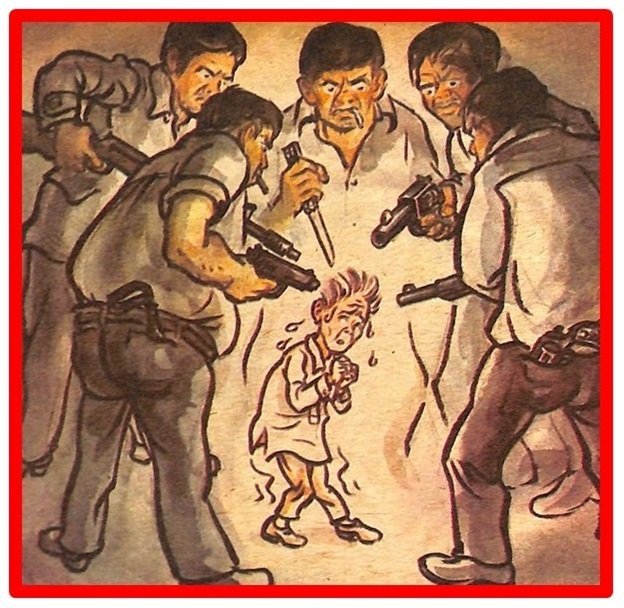
In the early 2000s, the Philippines made international headlines after two high-profile kidnapping cases involving Western tourists. From that moment on, the words PHILIPPINES and KIDNAPPING became inseparably linked in the global subconscious, reinforcing the image of a lawless and dangerous country.
Then you arrive in Manila… One of the first things a visitor notices is the heavily armed security guards standing in front of shops, banks, and malls. Even the calmest traveler may feel a chill run down their spine.
That chill turns into a full body cold sweat when you realize that malls and public buildings routinely inspect bags and scan people with handheld detectors to make sure no one is carrying explosives. If you happen to run into a police or military checkpoint, you may briefly wonder whether you accidentally landed in a country at war.
Eventually, it dawns on you: this isn’t a sign of chaos or unrest. It’s just how things are done here. Once you understand that armed guards and security checks are part of the local security culture – not evidence of an ongoing civil war – your sense of personal safety improves dramatically.
The final collapse of your initial shock and prejudice happens when you start interacting with locals. You quickly realize that Filipinos are not violent kidnappers, but overwhelmingly friendly, generally polite and non-confrontational. And the longer you stay, the clearer it becomes: the Philippines is far safer and calmer than its reputation suggests.
The Art of Staying Alive
The Philippines is a vast archipelago, and traveling here is about as safe – or as risky – as travel in any country of similar size. The dangers facing tourists are not exceptionally high, and most travelers never encounter genuinely dangerous situations.
Nearly 130 million people live here. In a population that large, things happen. But relative to the number of residents and tourists, serious crimes against visitors are reported surprisingly rarely.
Much also depends on your own behavior. Situational awareness, common sense, and the ability to read people and environments play a major role in how risky your experience becomes – and how safe you ultimately feel.
King Alcohol
Alcohol and tourism have a close, affectionate relationship in the Philippines. Drinking itself rarely causes major problems, and alcohol is available everywhere, around the clock. Travelers quickly learn that beer prices in supermarkets, corner stores, and bars are comparable to Coca-Cola.
From that moment on, some travelers effectively enroll themselves in a self-directed Fear Factor reality show. Shots are taken. Glasses are tilted. One drink becomes ten. Coordination fades. Judgment disappears. Suddenly, people are stumbling, confused, fearless, and profoundly convinced they’re immortal.
Excessive drinking in inappropriate settings becomes a genuine safety issue. You can absolutely enjoy alcohol responsibly in the Philippines, but there will always be travelers whose internal risk radar shuts down the second that little voice on their shoulder whispers: “Just one more.”
Traffic and Transportation
Driving in the Philippines feels as though traffic rules are gentle suggestions rather than actual laws. Driving styles can be aggressively creative and unpredictable – and safety is rarely a consideration.
Risk increases because the same roads are shared by trucks, buses, cars, motorcycles, bicycles, pedestrians, and livestock, all moving at wildly different speeds and stopping distances. Traffic is dangerous even when sober; driving drunk – whether in a car, on a motorcycle, or on a scooter – pushes the risk level into lethal territory.
In rural areas, vehicles often appear to be powered more by faith than by registration papers or safety inspections. Roads offer constant surprises in the form of potholes and suddenly appearing obstacles.
Most vehicles carry minimal insurance – if any at all. This becomes especially relevant if you decide to drive yourself. In the event of an accident, a foreigner’s legal protection rarely matches that of a local, and loud lectures about universal equality tend to change absolutely nothing.
On the water, the greatest risks come from renting small boats for independent trips. Boat condition and safety equipment usually meet only the local “no problem” standard. Captains’ risk tolerance can often be expanded with cash well beyond the limits of common sense. At that point, only prayer stands between you and disaster.
Violence and Crime
The Philippines is not uniformly violent in the same unpredictable way some European countries can be – where you might get punched for no apparent reason, anytime, anywhere. In the Philippines, you usually have some control over when and where you end up in the wrong place at the wrong time.
Large cities have neighborhoods where trouble is guaranteed – areas tourists are unlikely to wander into accidentally – especially not while loudly asserting their superiority and physical dominance. Petty theft and pickpocketing, driven by poverty, are common in crowded public transport and busy areas. Tourists do lose belongings, but these incidents rarely escalate into violence.
Filipino culture strongly favors conflict avoidance, sometimes to an almost frustrating degree. That said, if certain lines are crossed, Filipinos are perfectly capable of violence. Ironically, the greatest risk to travelers often comes from other travelers. In tourist bars, alcohol-fueled emotions spiral out of control just as they do everywhere else in the world. Every physical fight I’ve personally witnessed in the Philippines involved foreign tourists settling disputes with other foreign tourists.
Kidnappings
And yes – kidnappings. They do happen, and the country is known for them. But kidnapping is an extremely serious crime, not something done on impulse. It’s carried out by professional criminal groups who carefully research their targets and ensure immediate financial payoff. Ordinary tourists are not worth the risk and hold no appeal for professional kidnapping syndicates.
Foreigners are kidnapped, but victims are typically long-term residents – often wealthy Chinese or other Asian nationals – whose financial value has been carefully calculated in advance.
The infamous Abu Sayyaf kidnappings of Western tourists in the southern Philippines happened over twenty years ago. Today, with U.S.-assisted satellite surveillance and improved coastal monitoring, similar operations are no longer feasible, and groups capable of such attacks are no longer able to operate on islands like Jolo or Basilan.
Shooting Yourself in the Foot
Looking back through my own experiences, I can’t recall ever facing a credible threat of serious violence in the Philippines. What I have done repeatedly is endanger myself by actively walking into risky situations out of curiosity, stubbornness, or misplaced confidence.
I’ve lost my temper more than once, storming outside armed with a metaphorical baseball bat while common sense was still tying its shoes. I’ve cursed locals straight to hell, purgatory, and back – throwing gasoline to add to the flames. Yet even then, direct violence was never offered in return.
In recent years, I’ve noticed something interesting: the wind shaping safety perceptions seem to be blowing from west to east. Filipino friends increasingly ask how I dare visit Europe – let alone bring my family there. After all, Europe is full of crises, terror attacks, violent protests, school shootings, and, more recently, war.
I understand their concern. They view Europe through the lens of news media and form strong impressions based on headlines. If you look at Europe only through the news, it starts to feel like a place where testing your luck is a bad idea.
Gold Blinds Many – Love Blinds All
Travel can be deeply rewarding. It offers new perspectives, helps overcome fear, and introduces us to different cultures and people. When it comes to the last part, the Philippines deserves a bright red warning label.
For visitors, the greatest risk may not be crime or traffic – but falling in love. Filipino culture and attitudes toward foreigners contain many elements that resonate with emotional needs often neglected in Western societies. One of those elements is how easy it is to fall in love.
Love is like measles: the older the patient, the more dangerous it becomes. Love doesn’t kill or break hearts immediately – but it certainly can, if all associated risks materialize. Still, love is a risk worth considering seriously whenever it crosses your path.
