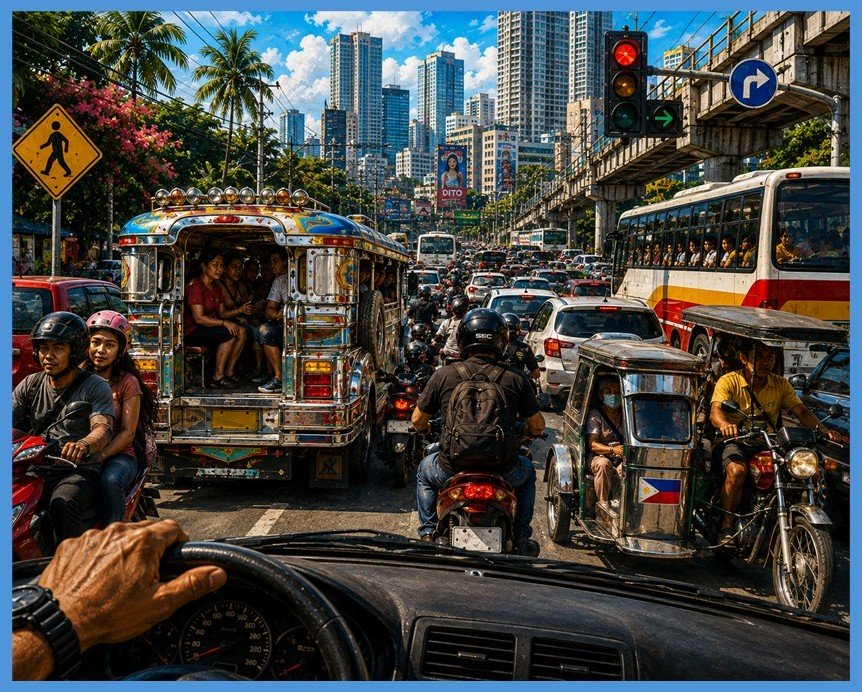
Many foreigners have the same first reaction to Philippine traffic: this cannot possibly work. Cars compete for space, motorcycles appear from impossible directions, jeepneys stop wherever they please, and drivers change lanes without consulting their turn signals.
Yet after some time behind the wheel, you begin to recognize a certain order beneath the chaos. Traffic is governed less by rules and road markings than by eye contact, vehicle movements, horns, and a shared understanding that everyone is improvising.
Traffic Rules Exist – but So Do Other Options
Vehicles drive on the right, steering wheels are on the left, and road signs are usually in English. On paper, the system looks perfectly understandable… Then you start driving.
Elsewhere, a painted lane divider is a firm statement. In the Philippines, it is more of a decorative suggestion. During rush hour, three marked lanes can become five, with motorcycles somehow squeezing into the remaining space.
This does not mean everyone drives recklessly. Many motorists proceed cautiously, constantly watching their surroundings because they cannot assume that other drivers will follow the rules.
Turn signals are another interesting concept. Switch one on in heavy traffic, and the driver behind you may interpret it as a declaration of war, accelerating to close the gap before you steal their precious position.
Right-of-way is similarly negotiable. At intersections, priority often goes to whoever manages to position their vehicle so that nobody else can physically continue. It is not necessarily aggression – more often, a slow and surprisingly polite struggle for dominance.
The horn completes the system. A short beep may mean ”I’m here,” ”Watch out,” ”I’m coming through,” or almost anything else. It is the Tagalog of traffic, a language you gradually learn without ever studying its grammar.
Driving in the Cities and the Provinces
In Metro Manila, an eight-kilometer journey is better understood as a difficult phase of life than as a distance. It may take 20 minutes or two hours, depending on traffic and the mood of the universe. Manileños rarely ask how far away somewhere is. They want to know how long it will take and when they should leave.
Changing lanes requires patience and determination. You inch forward, centimeter by centimeter, until the driver beside you must decide which of you wants the space more. Motorcycles and scooters add their own challenges. They appear between cars, beside your mirrors, and in your blind spots so quickly that you begin to suspect they reproduce through cell division.
A jeepney may stop wherever a passenger happens to be waiting, while buses and trucks enjoy an advantage that has little to do with traffic regulations: mass. Two vehicles may have equal rights, but when one weighs twelve tons more, yielding is usually the wiser choice.
Parking introduces another local specialist. Approach any possible parking space, and a self-appointed attendant materializes from nowhere, waving you backward toward a concrete barrier. ”It’s okay, sir! Back! Back! A little more!” Should disaster strike, this master of spatial logistics will vanish faster than an insurance company when it’s time to pay a claim.
Outside Metro Manila, the scenery changes. Rice fields, coconut palms, and small villages replace concrete, and driving occasionally becomes genuinely enjoyable. Then, around the next bend, you encounter a tricycle crawling at 20 kilometers per hour, a sleeping dog, or a highway lane temporarily converted into a rice-drying facility.
In the Philippines, a road is never merely a transportation route. It is also a workplace, marketplace, living room, and occasional animal daycare center.
Safety and Accidents
The humor disappears when the consequences turn deadly. More than 10,000 people die on Philippine roads annually, and road traffic injuries are among the leading causes of death for young people.
Speeding, dangerous overtaking, distracted driving, and poor judgment contribute to the problem. Motorcyclists, cyclists, and tricycle passengers are particularly vulnerable. The safest approach is therefore mild paranoia: assuming someone nearby is about to do something unexpected and not especially logical.
Pedestrians occupy the bottom of the traffic food chain. A crosswalk often provides little protection beyond a few white lines painted on the asphalt. Crossing may involve raising your palm toward an approaching bus and hoping its driver is better at palm reading than physics.
The rainy season adds another challenge. Tropical downpours can turn streets into rivers within minutes, making water depth difficult to judge. Higher ground clearance is therefore not necessarily just an SUV owner’s status symbol but a practical advantage.
I also avoid unfamiliar rural roads at night whenever possible. Unlit vehicles are common enough to make driving hazardous. The tricycle ahead may rely on a faded Jesus Is My Co-Driver sticker as its only reflector, while an approaching truck saves electricity by switching on its high beams only a split second before it’s game over.
Driver’s Licenses
Foreign visitors can generally drive using a valid foreign driver’s license for up to 90 days after arrival, subject to applicable requirements. An English translation or international driving permit may be useful, particularly when the original license is not in English.
In practice, roadside encounters do not always go by the book. A traffic officer examines your foreign license, looks at you, and then watches a 110 cc scooter pass carrying five people without helmets, the youngest holding a live pig. After briefly reconsidering his priorities, he decides that your mysterious plastic card probably deserves the benefit of the doubt.
For longer stays, obtaining a Philippine driver’s license is advisable. Converting a foreign license requires proof of identity, immigration documents, a medical examination, and a visit to the Land Transportation Office (LTO).
Unfortunately, Philippine bureaucracy has its own traffic rules. Procedures may vary between offices, and knowing the official requirements does not always guarantee a predictable experience. Sometimes success depends on which counter you approach, how you explain your situation, and the employee’s blood sugar level at that particular moment.
The First Stage of Traffic Enlightenment
Ultimately, Philippine driving is learned through experience rather than theory. After enough kilometers, the traffic that once resembled an apocalyptic circus begins to feel strangely normal.
You anticipate a jeepney’s sudden stop before its driver has decided to stop. You sense motorcycles approaching from your blind spots. You recognize an impending lane change simply by watching the angle of another car’s front wheels long before its driver considers using a turn signal.
Then comes the unsettling realization: you are driving like a Filipino. The second lesson is equally important: whatever happens, do not get angry. Raging at Philippine traffic is about as useful as shouting at a monsoon. It will not move the bus, clear the congestion, or persuade the jeepney to disappear.
Once you have mastered anticipation and patience, you have achieved the first stage of Philippine traffic enlightenment. You no longer wonder how chaos works. You have become part of it.
More on the topic:
Motorbiking in the Philippines
