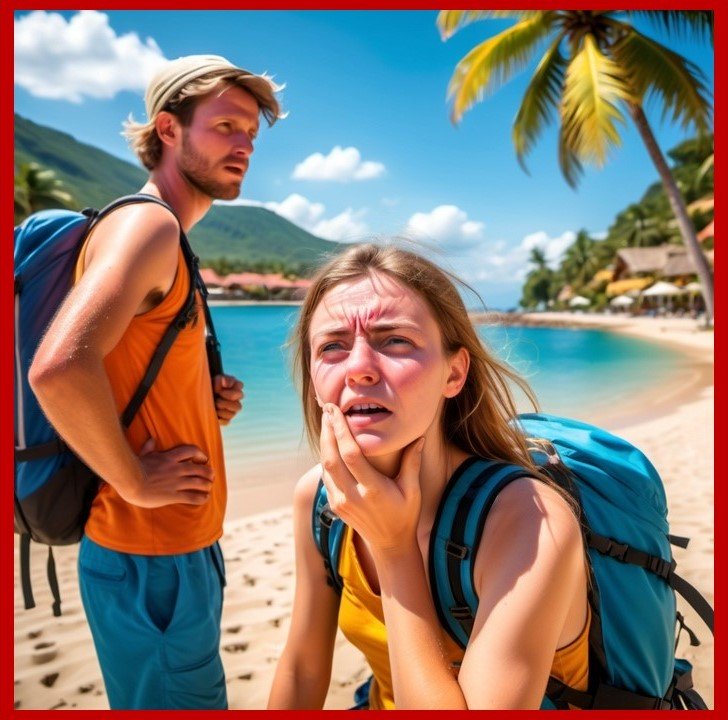
Stomach bugs, mosquito bites, tropical sun, traffic, and your own questionable decisions are all things you can prepare for on vacation – or simply leave to fate. Keep your head cooler than your beer, and the Philippines will probably reward you with a wonderful trip and relatively few unwanted side effects.
The Philippines: thousands of tropical islands, swaying palm trees, crystal-clear seas, white beaches, and warm breezes gently caressing your sun-kissed skin. Paradise, in other words.
Just don’t let the brochure fool you. Every paradise has a snake somewhere in the grass. Sometimes it is a mosquito. Sometimes a bacterium. And surprisingly often, it is you.
Most visitors return home perfectly intact, usually with a tan, too many photographs, and strong opinions about mangoes. But tropical travel does come with risks. The trick is knowing which ones deserve attention and which ones deserve nothing more than common sense.
Self-Inflicted Risks – Living Life on the Edge
Even in the Philippines, the greatest threat to a traveler is often the traveler. Why stroll peacefully along a white-sand beach when you can jump off a waterfall, spend three nights in a bar trying to resurrect your lost youth, or convince yourself that a scooter can easily carry four drunk adults and a surfboard?
Locals often watch these experiments with quiet amusement. Years of living in the tropics have taught them a thing or two. Tourists, meanwhile, have just arrived with travel insurance and plenty of confidence. They haven’t yet figured out which of the locals’ daily stunts are routine and which ones even the locals consider a terrible idea.
A little common sense and some awareness of your limitations can keep your vacation from becoming the story of how you ended up in a provincial hospital with an improvised arm splint while your insurance company plays cheerful hold music.
Cuts and Bites – The Bacterial Academy Awards
The tropics provide enough surprises without your assistance. Even small cuts, scratches, and bites deserve respect. Tropical bacteria, unlike most government offices, tend to work quickly and rarely take lunch breaks.
Step on an innocent-looking piece of coral or a sharp shell and you may accidentally launch an infection drama in which exotic bacteria begin competing for Best Supporting Microorganism.
Insects are equally capable of introducing you to swelling, inflammation, and fever. What looks like a heroic little scratch on Monday can turn into something requiring considerably more professional attention by Wednesday.
The strategy is boring but effective: clean wounds and bites thoroughly and keep an eye on them. Increasing redness, heat, swelling, or pain should always be taken seriously.
Stomach Bugs – When the Vacation Continues but the Fun Doesn’t
Many travelers arrive wondering whether they will spend more time on the beach or in the bathroom. Fortunately, the Philippines has plenty of food worth trying, and street stalls and local markets can provide some of the best experiences of your trip. Occasionally, however, the experience becomes unforgettable for reasons your stomach understands better than your taste buds.
A useful rule is wonderfully primitive. If the food is freshly cooked and steaming hot, with actual fire under the pot, you can usually approach it with reasonable confidence. Food that has spent the afternoon at room temperature while being inspected by an enthusiastic committee of flies deserves more thought.
Keep Imodium or whatever antidiarrheal medicine works for you on hand. An attack of diarrhea on a packed bus is not the cultural exchange most travelers hope to share with strangers.
Drinking Water – Adventures in Liquid Form
If you have doubts about the drinking water, choose bottled water unless you want to turn your vacation into an advanced survival course for the digestive system.
Tap water may be fine for washing and other everyday uses, but boiling remains an old-fashioned and effective precaution when needed. A few minutes of bubbling in a pot can save considerably more bubbling later.
Be equally cautious with suspicious roadside bottles and ice of mysterious ancestry. Sometimes a warm drink is preferable to conducting your own field research into the Philippine healthcare system.
Dengue Fever – Mosquitoes That Love You Too Much
Dengue is not a tropical urban legend invented by the mosquito-repellent industry. It is a genuine concern in the Philippines. The mosquitoes responsible are impressively democratic. Locals, foreigners, rich people, poor people, backpackers, and honeymooners are all treated equally.
Dengue can cause high fever, severe aches and pains, and, in serious cases, complications requiring hospitalization. That risk doesn’t mean you should spend your vacation sealed inside an air-conditioned hotel room.
When visiting a new destination, check whether dengue cases have recently been reported there. If dengue is circulating, repellent and clothing that covers the skin are sensible precautions. The mosquitoes that spread dengue are especially active during the daytime.
And those picturesque pools of standing water? Admire them from a distance. The mosquitoes may already be holding their own beach party there, and you are the buffet.
Sun and Heat – The Tropics’ Unbeatable Tag Team
The Philippine sun invites you outside with turquoise water and perfect vacation photographs. Then it attempts to cook you. Think of the sun as an enormous barbecue grill. You are the steak.
High-SPF sunscreen is therefore a useful friend if your plans include beaches, boats, snorkeling, or hours under a tropical sky. Heat can also dehydrate you faster than expected, so drink regularly even when you are not particularly thirsty.
And when Filipinos retreat into the shade, carry umbrellas, or wear long sleeves while you proudly roast yourself at noon, consider the possibility that they know something you don’t. They live there – you arrived on Tuesday.
Traffic – Skill, Luck, and Divine Intervention
Philippine traffic can resemble an action movie whose director went home halfway through filming and left the extras to improvise.
An astonishing variety of vehicles – and drivers with equally varied interpretations of physics – share the roads. Traffic rules can occasionally seem more like suggestions than commandments.
As a pedestrian, you occupy roughly the same position in the transportation hierarchy as a traffic cone. Look carefully before stepping into the road. At least then you have a fair chance of identifying what is about to hit you.
A scooter can feel wonderfully liberating until you find yourself weaving between cars, dogs, tricycles, buses, potholes, and overloaded trucks on roads where avoiding collisions is less a science than a performing art.
On the Water – Fifty Shades of Tropical Risk
The underwater world of the Philippines offers spectacular experiences – and an impressive selection of ways to hurt yourself. Diving equipment can fail. Your skills can fail. Coral can cut you. Jellyfish can sting you. Sea urchins can introduce themselves by way of the sole of your foot.
Cuts and stings should be cleaned carefully, and signs of infection deserve attention. Marine environments are full of bacteria you probably do not want establishing permanent residency in your body.
For something gentler, try paddleboarding, kayaking, or exploring mangrove-lined rivers. You still get the tropical adventure with less opportunity to become the emergency room’s evening entertainment.
Sexually Transmitted Infections – The Souvenir Lottery Nobody Wants to Win
Unprotected casual sex can be a little like spending all day on a tropical beach without sunscreen: tempting at the beginning, potentially burning by the end.
The number of newly reported HIV diagnoses has increased in recent years, but HIV is not the only sexually transmitted infection worth remembering. Chlamydia, gonorrhea, and others are also part of the equation.
Commercial sex does not automatically make that equation safer, even where sex workers undergo regular health checks. Testing cannot eliminate risk, and a health certificate is not an invisible force field.
So along with your sunscreen, passport, and questionable tropical shirts, pack condoms that you already know fit properly. It is one travel accessory you really don’t want to discover is the wrong size at the crucial moment.
Alcohol – Always Ready to Help You Get Into Trouble
Alcohol is part of vacation life for many travelers, but even paradise has limits. Too much alcohol can leave you with more than a hangover and a missing phone. Tropical heat and alcohol are not exactly a medical dream team either: dehydration can sneak up while you sit happily at a bar wondering why everyone has suddenly become so interesting.
Alcohol also encourages decisions that look less brilliant the following morning. Perhaps you chose a karaoke song three octaves beyond your abilities. Perhaps you tried to negotiate something using English, hand gestures, and confidence unsupported by facts.
Moderation remains remarkably effective. As a general rule, the best nights are the ones you can remember at least partially.
Worries from Another Era
Broadly speaking, the Philippines presents many of the same kinds of travel risks found elsewhere in Southeast Asia. Some health threats that once dominated travel advice have become less common, while others can usually be managed with sensible precautions.
Malaria is now limited to certain parts of the Philippines, although transmission still occurs in certain areas and circumstances. Where it is present, protection from mosquito bites, especially from dusk through the night, matters.
Rabies remains a concern, especially with stray animals. Children deserve special attention because they possess a mysterious, universal desire to pet every dog and cat they encounter. Animal bites and scratches should be taken seriously. Prior vaccination can simplify treatment, but medical evaluation after a possible exposure is still important.
Tuberculosis is another concern; it spreads most easily through prolonged close contact in crowded spaces. Hepatitis, especially hepatitis A, is also worth keeping in mind, although appropriate vaccinations and ordinary food and water precautions can greatly reduce the risks.
None of this means spending your vacation staring suspiciously at everyone who coughs as though you had personally been appointed director of airport quarantine. A little awareness travels well. Paranoia requires considerably more luggage.
The Greatest Travel Risk Is Never Going
Travel has never been completely safe. Neither has staying home, crossing a street, falling in love, starting a business, raising children, or trusting the expiration date on something you found at the back of the refrigerator.
Health risks in tropical countries can differ from those back home. Understanding them is sensible. Allowing them to dictate your entire life is something else.
Accepting risk does not mean behaving recklessly. It means understanding the risks, taking reasonable precautions, avoiding particularly stupid decisions, and then getting on with your life.
Years from now, the things you regret most will probably not be the sensible risks you took. They will be the adventures you were too afraid to have.
Motorbiking in the Philippines
