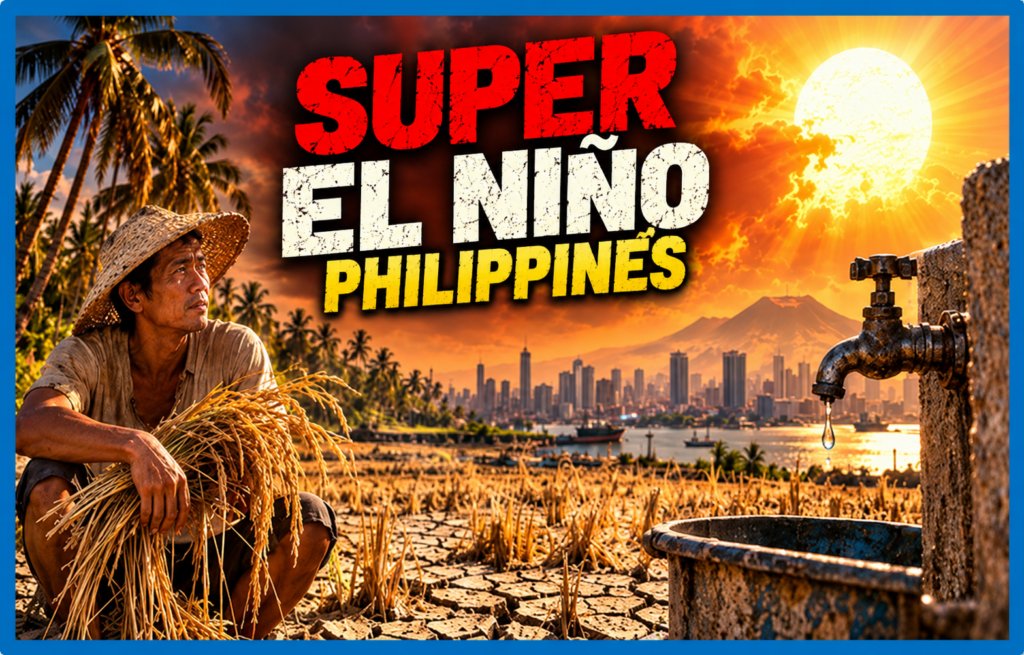
A very strong El Niño has developed in the Pacific Ocean, threatening to bring unusually intense heat, drought, and a host of problems to the Philippines, affecting everything from rice paddies to Manila’s high-rise condominiums.
While people in cooler climates dream of summer, those in the Philippines sometimes find themselves counting the days until the hottest months are over. When the thermometer hits 36°C (97°F) and the humidity turns the air into a poorly ventilated sauna, even a chilly, rainy autumn day begins to sound surprisingly appealing.
El Niño could make the coming dry season even drier than usual. In the worst cases, drought can drag on for months, leaving crops struggling and reservoir levels steadily declining. In the Philippines, a shortage of water is not the kind of problem that can be solved by finding some shade and ordering another cold drink.
For agriculture, drought can be disastrous. Rice cultivation requires enormous amounts of water, and even coconut palms cannot survive on tropical optimism alone. When irrigation canals run dry, harvests shrink and farmers’ incomes dry up along with them. Eventually, the consequences reach the markets, where rising rice and vegetable prices affect even those who have never set foot in a rice field.
In the sprawling metropolis of Metro Manila, the problems take a different form. Much of the capital region’s water supply comes from the Angat Reservoir, which relies on regular rainfall to maintain adequate reserves. If water levels fall too far, authorities may have to restrict water distribution, while hydroelectric power generation may also suffer. For someone living in a high-rise condominium, drought becomes a very personal matter the moment the shower produces nothing but air and the air conditioner goes silent during a power outage.
El Niño does not, however, mean that the entire country will turn into a barren desert. Weather conditions vary considerably across the Philippine archipelago, and even during a powerful El Niño, heavy rainfall, flooding, and typhoons remain possible. The tropical climate has never shown much interest in behaving consistently, let alone according to human expectations.
What Exactly Is El Niño?
El Niño is not a typhoon, a storm, or a giant mass of hot air hovering over the Philippines. It is a large-scale climate phenomenon driven by changes in Pacific Ocean temperatures and atmospheric circulation that affect weather patterns across the globe. The name El Niño, Spanish for ”the little boy,” refers to the Christ Child and originated with fishermen along the Peruvian coast, who noticed that unusually warm ocean waters tended to appear around Christmas.
Under normal conditions, trade winds push warm surface water westward across the Pacific, from South America toward Southeast Asia. The warm waters of the western Pacific promote evaporation and the formation of rain clouds, often bringing heavy rainfall. Meanwhile, along the South American coast, cooler water rises from the depths to replace the water pushed westward.
During El Niño, these winds weaken, allowing warm water to spread toward the central and eastern Pacific. Rainfall patterns shift eastward as well. For Southeast Asia, including the Philippines, this often means less rainfall than usual, hotter conditions, and an increased risk of drought.
But what turns an ordinary El Niño into a Super El Niño? Super El Niño is an informal term for an exceptionally intense El Niño event. PAGASA (Philippine Atmospheric, Geophysical and Astronomical Services Administration) classifies an El Niño event as very strong when average sea surface temperatures in the central and eastern equatorial Pacific are at least 2°C (3.6°F) above their long-term average.
Warmer ocean waters influence winds, rainfall, and weather patterns across vast regions, but the effects vary considerably from place to place. A stronger El Niño generally increases the risk of severe weather disruptions, although its local effects are not always predictable.
Drought Is an Old and Unwelcome Visitor
The Philippines has experienced El Niño many times, although no two episodes have been exactly alike. Particularly powerful events in 1982–1983, 1997–1998, and 2015–2016 left deep scars across the country, damaging agriculture, disrupting water supplies, and threatening ordinary people’s livelihoods. After all, the scale of a natural disaster is measured not only in destroyed buildings but also in crops that wither before they can be harvested.
The 1997–1998 El Niño was among the strongest of the twentieth century. Drought hit agricultural regions particularly hard, irrigation water became scarce, and hydroelectric power generation suffered. On Mindanao, for example, where hydropower accounted for a substantial share of electricity generation at the time, water shortages quickly demonstrated how a climate phenomenon can turn into an energy crisis. During a blackout, refrigerators, water pumps, and air conditioners become about as useful as flashlights without batteries.
The 2015–2016 drought once again caused major agricultural losses, leaving many rice farmers desperate. In some areas, that desperation eventually spilled over into social unrest. In April 2016, a demonstration by drought-stricken farmers in Kidapawan ended in violent clashes. The events offered a grim reminder that El Niño is not merely a concern for meteorologists. When food runs out and desperately needed assistance fails to arrive, the weather has an unfortunate habit of becoming political.
The 2023–2024 El Niño remains fresh in people’s memories. PAGASA announced in June 2024 that El Niño had ended, although some of its effects lingered. The country certainly has plenty of experience dealing with El Niño. Unfortunately, by the time the lessons learned have traveled from one government department to another, survived budget negotiations, and escaped the depths of some bureaucrat’s desk drawer, the next drought may already be knocking at the door.
Preparing for Super El Niño – Easier Said Than Done
As 2026 draws to a close, El Niño has become more than a worrying forecast. In early November, PAGASA confirmed that the event had reached very strong intensity, with its peak expected around the end of the year. The phenomenon is forecast to persist into the first half of 2027, although the severity of its consequences across the Philippines remains uncertain. By the end of October 2026, five Philippine provinces were already experiencing meteorological drought, eleven were affected by dry spells, and another ten were experiencing unusually dry conditions.
PAGASA continuously monitors Pacific Ocean temperatures, rainfall patterns, and developing drought conditions, issuing warnings and advisories to local governments. In agriculture, preparations include conserving irrigation water, adjusting planting schedules, and introducing more drought-resistant crop varieties. Water authorities, meanwhile, aim to manage reservoir levels to ensure adequate supplies throughout the harshest months of the dry season.
The Philippines has never suffered from a shortage of plans. The more difficult question is how effectively those plans translate into practical action in provinces where irrigation systems are aging, municipal budgets are stretched thin, and communities depend heavily on local rainfall, wells, and small-scale water systems.
In the city, drought may mean scheduled water outages. In a remote village, a dried-up well may mean walking several miles to the nearest functioning water source. At an official government briefing, both situations can nevertheless be summarized under the same reassuring announcement: the situation is under control. The main difference is who still has drinking water when the press conference is over.
Climate change adds another complication. Although El Niño is a natural phenomenon, it now occurs in a warmer world, where higher temperatures can accelerate evaporation and dry out the soil with alarming efficiency. Not every individual heat wave can be blamed on El Niño, of course, although it does make a remarkably convenient scapegoat for almost anything that goes wrong.
And What About Your Vacation Plans?
For travelers dreaming of a tropical beach vacation, El Niño may initially sound like excellent news: less rain, more sunshine, and better odds of enjoying uninterrupted days at the beach.
Unfortunately, reality is somewhat more complicated. When the heat index climbs above 40°C (104°F), visitors quickly discover why Filipinos enjoy spending their free time in shopping malls where the indoor temperature feels more like a cool autumn afternoon than a tropical summer.
The heat can be particularly oppressive from March through May. Plan outdoor activities for the early morning or evening, drink plenty of water, and avoid long excursions under the midday sun. Children, older adults, and people with chronic medical conditions are especially vulnerable to heat exhaustion. Heatstroke is a life-threatening medical emergency, and a cold bottle of San Miguel beer, however tempting, is not an acceptable treatment.
El Niño alone does not determine the weather during any given week of your vacation, as conditions vary considerably between destinations. The mountain climate of Baguio is generally cooler than Manila’s, although water shortages can still become a problem there. In popular island destinations such as Palawan and Boracay, travelers would be wise to check in advance whether their accommodations have reliable water supplies and backup power systems in case of outages.
Visitors should also remember that life in the Philippines has always unfolded largely on nature’s terms. Typhoons, earthquakes, and volcanic eruptions have taught Filipinos that life cannot always be planned down to the last minute, no matter how perfectly organized a traveler’s itinerary may look on paper. El Niño introduces an additional twist: this time, the problem may be the absence of the very water that normally arrives in overwhelming quantities.
As Super El Niño unfolds over the coming months, its consequences are likely to be anything but evenly distributed. In an air-conditioned condominium in Makati, drought may mean little more than a higher electricity bill and a shorter shower. For a rice farmer in the countryside, it may mean a failed harvest and the loss of everything his family depends on.
Both live under the same scorching sun. But only one of them has a remote control for the air conditioner.
Further reading:
