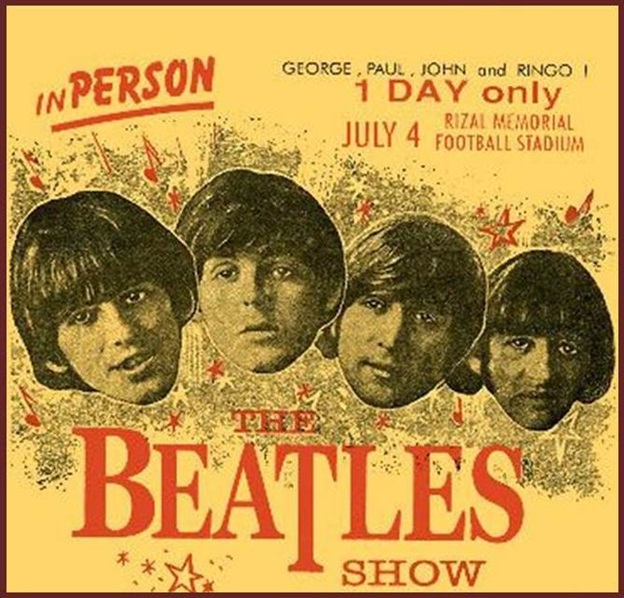
In the Philippines, global superstars are treated like visiting royalty, and fans practically worship the air they breathe and the ground they walk on. But when things go wrong, even stars are quickly reduced to mere mortals.
Every year, millions of foreigners arrive in the Philippines. Most have a wonderful time, enjoying the beaches and islands, the agreeable climate, and the famously warm hospitality of the people.
Every now and then, however, a visit turns into something less glowing. Sometimes it becomes downright awful – even dangerous. That’s exactly what happened to four young Englishmen known collectively as the Beatles.
She Loves You
The Beatles had already made their way into millions of homes through radios and record players, inviting young people into a new era where music whispered that love, freedom, sex, and even drugs might be part of the fun. Even Imelda Marcos heard the call – and wanted a piece of Beatlemania for herself.
Tasked with making it happen was a show business insider and friend of the presidential couple, Ramon Ramos, along with his company Cavalcade International Productions. In early 1966, Ramos contacted the band’s manager Brian Epstein, who was arranging a summer tour that included West Germany and Japan.
The Philippines was added as the final stop after Japan. The original venue, Araneta Coliseum, proved too small due to overwhelming demand, so the concerts were moved to the larger Rizal Memorial Football Stadium. An additional afternoon concert was also added to the schedule.
Happiness Is a Warm Gun
On the morning of July 3, the Beatles and their entourage flew out of Japan, making a brief stopover in Hong Kong. While the plane refueled, the band members stretched out in the airport’s VIP lounge – grabbing a moment of calm before the next act of the tour, which, as it turned out, would not follow the usual script.
Their Cathay Pacific flight touched down at 4:30 PM at Manila International Airport – today known as Ninoy Aquino International Airport – where hundreds of fans were waiting to greet them. But the first thing the Beatles noticed wasn’t the fans. It was the guns.
Armed guards and soldiers seemed to be everywhere. The band reportedly wondered out loud whether there was some kind of war going on. Instead of the usual airport routine, they were given VIP treatment reserved for diplomats: immigration formalities handled quickly in a private room, well out of sight of ordinary travelers.
Once outside the terminal, plainclothes escorts – also armed, just to keep things consistent – guided the band into waiting cars. Brian Epstein and the rest of the entourage were directed into separate vehicles, with no explanation and with no say in the matter.
The Beatles themselves were driven not to their hotel, but to Manila Harbor, specifically the headquarters of the Philippine Navy. There, a quick press conference was arranged for about 40 journalists. Meanwhile, Epstein and the rest of the group were taken straight to the hotel and left wondering where exactly their headline act had disappeared to, and why nobody seemed particularly interested in telling them.
Yellow Submarine
After the press conference, the soldiers escorted the Beatles – not to their hotel, as one might reasonably expect – but to a luxury yacht waiting in the harbor.
The vessel belonged to wealthy Filipino businessman Manolo Elizalde, who, together with his son, had decided that the proper way to welcome the Beatles was to parade them in front of friends and take them on a leisurely cruise around Manila Bay.
Elizalde happened to be an associate of promoter Ramon Ramos, and the two had also agreed – quietly, and without troubling anyone with unnecessary details – that the Beatles would spend the night on the yacht. It was, in their view, a safer option than a hotel. Curiously, this plan was never shared with Brian Epstein, the man actually responsible for the band’s travel arrangements.
As the skyline of Manila slowly faded into the distance, the mood on board shifted from confusion to something closer to disbelief. The Beatles, exhausted from their journey, had been looking forward to nothing more ambitious than a bed and a few hours of uninterrupted sleep. Instead, they found themselves out at sea, separated from their manager and entourage, surrounded by strangers, and guarded by soldiers.
After spending nearly the entire night aboard under military watch, the band was finally brought back to shore. From there, they were driven to the Manila Hotel, where Epstein had booked their rooms. The mop-topped icons of a generation finally made it to bed at around 4:00 in the morning – just in time to start wondering what, exactly, counted as normal anymore.
Can’t Buy Me Love
The Beatles slept in late the next morning. They had breakfast served in their hotel rooms when, quite suddenly, soldiers from the presidential security detail arrived to escort them to a gala organized by Imelda Marcos in their honor at Malacañang Palace.
Brian Epstein made it very clear, in his usual no-nonsense tone, that the band was not to be disturbed. He asked that a message be delivered to the presidential palace: the Beatles had come to the Philippines to perform two concerts for their fans, and they needed their rest to be able to do exactly that.
As far back as 1964, the group had followed a firm rule – no embassy receptions, no state banquets, no polite little diplomatic parties thrown in their name during tours. Fame, yes. Formalities, no thank you.
Beatles’ tour manager Vic Lewis had already received an official courtesy invitation to the palace while the band was still in Tokyo. He wisely chose not to mention it to Epstein, fully aware of what the answer would be.
I Don’t Want to Spoil the Party
Meanwhile, the Filipino promoter Ramos did not dare inform the palace that the invitation had been declined. So, he quietly held on to hope – perhaps, once the Beatles actually landed, they would “feel differently.”
Not long after Epstein’s refusal, he received a phone call from Leslie Minford, the Chargé d’Affaires at the British Embassy, who applied considerable pressure for the group to attend the First Lady’s event immediately. Epstein did not budge. He did not even consult the band. At that moment, the Beatles themselves remained blissfully unaware that their absence had created a diplomatic emergency.
They only found out shortly before leaving for their first concert, when hotel staff casually informed them that Imelda Marcos was “very angry.” John Lennon, still half-asleep and fully unimpressed, asked the only reasonable question in the situation: “Who is Imelda Marcos?”
A short while later, they caught a glimpse of the unfolding drama on live television. The broadcast showed Malacañang Palace: rows of empty chairs with the Beatles’ name tags neatly placed on them, children crying in confusion, and the First Lady herself speaking to the cameras – declaring that the Beatles had personally insulted her and disappointed the children who had been waiting for them.
And so, in the grand theater of international misunderstandings, a pop band’s afternoon nap had somehow turned into a national incident.
A Day in the Life
The Beatles kicked off the first of their two concerts at Rizal Memorial Football Stadium at 4:00 in the afternoon. The band performed on a small, covered stage placed at one end of the arena, almost like a modest island in a sea of screaming humanity.
Some 30,000 fans had already gathered for the early show, welcoming the group with a warmth that cut through the humid Manila air like an electric current. The second concert followed at 8:30 in the evening, drawing an even larger crowd of about 50,000 eager listeners.
Across both shows, the Beatles played the same 11-song set. They opened with Chuck Berry’s “Rock and Roll Music,” as if paying tribute to the roots from which it all grew, before moving into a tightly packed selection of Beatles originals: “She’s a Woman,” “If I Needed Someone,” “Day Tripper,” “Baby’s in Black,” “I Feel Fine,” “Yesterday,” “I Wanna Be Your Man,” “Nowhere Man,” “Paperback Writer,” and finally closing with the explosive “I’m Down.”
In total, the combined attendance for the day reached 80,000 people, making it the largest single-day audience the Beatles had ever performed for at that time. Only one concert in their history had drawn a bigger crowd for a single show: their legendary first Shea Stadium performance in New York in August 1965, where 55,600 fans filled the stands in a thunderous wave of sound and hysteria.
Advance tickets for seated sections were priced at 30 pesos, while standing room on the field cost 20 pesos. At the exchange rates of the time, total ticket sales from the two concerts came to nearly $100,000. After subtracting the Beatles’ performance fee of $37,000, the local promoter still walked away with a comfortable profit – enough to make the whole enterprise feel less like madness and more like very profitable chaos.
Taxman
While the Beatles were resting between their two concerts, Brian Epstein recorded a statement to clarify why the band had not attended the children’s party at Malacañang Palace. It was a straightforward attempt to smooth things over.
But when the message aired on television later that evening, the sound was – quite mysteriously – cut off. Whether by accident or design, the explanation never reached the audience that mattered.
The backlash began almost immediately after the second concert, as the band set out for their hotel. Their convoy was briefly trapped behind a closed gate, giving a group of local troublemakers just enough time to surround the cars and hurl insults with impressive enthusiasm and very little creativity. Eventually, the gates opened, the convoy moved, and the band made it back to the hotel, where they retreated to their rooms and tried to sleep off what was quickly turning into a public relations disaster.
During the night, police picked up Vic Lewis – the intermediary between the band and promoter Ramon Ramos – and took him to the tax office for a three-hour session to sort out what officials described as “technical issues” related to income tax.
At the tax office, officials produced a calculation based on the band’s performance fee, which was still sitting in the hands of the promoter. They demanded immediate payment of taxes as a condition for allowing the band to leave the country.
This, despite the small but rather important detail in the contract between the Beatles and Cavalcade International Productions: the local promoter was supposed to handle – and pay – all local taxes. In other words, the bill had already been assigned. It just hadn’t been paid – at least not by the people now being asked to settle it on the spot.
The Long and Winding Road
The Beatles woke up early on July 5. Their room service requests went unanswered, and the hotel staff made no effort to attend to them. Down in the lobby, they were met by newspaper headlines screaming that the Beatles had betrayed the First Lady and left hundreds of children crying in disappointment, as if pop music had suddenly become a matter of international morality.
When the band and their entourage finally checked out, they carried their own luggage across a long stretch of the parking area to the cars waiting far away from the hotel entrance. It was not exactly the kind of farewell usually reserved for visiting world-famous musicians – more like a discreet eviction.
On the way to the airport, things somehow became even more surreal. The drivers appeared to have temporarily forgotten where they were going. The convoy circled roundabouts more than once, made puzzling detours, and generally behaved like it was being guided by confusion rather than navigation.
At one point, Brian Epstein had to call the airport and request that a KLM flight be delayed, because it was becoming painfully clear they were not going to arrive on time.
At the airport, staff had been instructed not to assist the Beatles or their party. Even the escalators seemed to have joined the protest – reportedly “breaking down” as they approached, forcing the band and crew to haul heavy amplifiers, instrument cases, and luggage up and down stairways like reluctant porters in an uncooperative building.
To make matters worse, they were directed through a narrow passage formed by soldiers and airport personnel. Instead of a warm send-off, they walked through a corridor of hostility – pushed, mocked, and treated not as guests but as a problem to be forcibly expelled.
Run for Your Life
Finally, the Beatles made it into the airport departure hall, where things took on an almost absurd theatrical quality. They were told to move back and forth across the room – from one corner to another – as if confusion had become the procedure.
Someone shouted instructions that sounded more like a verdict than airport guidance: “The Beatles are not VIP passengers! You will be treated like ordinary travelers! You are ordinary travelers!” Years later, John Lennon would dryly reflect in interviews: “But ordinary passengers don’t usually get kicked and beaten, do they?”
The band ultimately managed to slip out of the airport unharmed by blending into a group of monks and nuns who had arrived at the same time for check-in. In this unexpected disguise of faith and serenity, they were able to complete their exit formalities and move through immigration without further obstruction. But the trouble did not end there.
HELP!
As they walked toward the aircraft waiting on the tarmac, a hostile crowd – allowed into the airport grounds – surrounded them. They were shoved, spat upon, and met with chants of “Beatles, alis dyan!” – a rough command meaning “Beatles, get out of here!”
The band’s road crew did what they could, forming a protective barrier around John, Paul, George, and Ringo, shielding them from blows and shoves. It was less escort, more human shield in an atmosphere that had turned sharply from celebration to rejection. Eventually, they reached the plane and climbed aboard to safety.
Paul McCartney later summed up the surreal relief of that moment with understated irony: “When we got on the plane, we all kissed the seats.”
I Should Have Known Better
The plane was already set to depart when the cabin door suddenly swung open and military police boarded – their submachine guns making the message clear without the need for words.
They ordered Brian Epstein and his assistant Neil Aspinall to return to the terminal. The official reason: “irregularities” with their passports – and the small matter of the band’s unpaid taxes.
After a brief and tense negotiation, another member of the entourage went back with the officers to sort things out. The passport issue, unsurprisingly, dissolved under scrutiny. The tax issue, however, proved more stubborn. In the end, a personal bank guarantee of £6,800 had to be secured – covering taxes for income the Beatles never even received.
Eventually, the paperwork was deemed satisfactory, the authorities stepped aside, and the men were allowed back on board. Only then did the aircraft finally leave Manila – carrying with it four very famous passengers who had just learned that, in some places, even superstardom doesn’t protect against hostile bureaucracy.
Let It Be
The following day, July 6, Ferdinand Marcos stepped in with a calming statement, adopting the tone of a man trying to put the genie back in the bottle. He said he understood that the Beatles had not deliberately skipped his wife’s children’s party. According to him, the chaos and violence at the airport was simply an overreaction – an unfortunate case of national pride tripping over a rather embarrassing “misunderstanding.” As a gesture of goodwill, he also canceled the tax that had been imposed on the band’s earnings.
A few years later, Imelda Marcos offered her own version of events, smoothing the wrinkles of history with practiced elegance. She insisted she hadn’t taken the incident as a personal insult.
“As a devoted fan of the Beatles, I invited them to Malacañang Palace so I could personally welcome them together with my family and friends, who are also great admirers. Of course, I was disappointed when they didn’t come – but I understood that it was due to a breakdown in communication, and I never held it against them.”
Hello, Goodbye
The Beatles and their entourage landed back in London at Heathrow Airport in the early hours of July 8. Waiting for them was a television interview, where they wasted no time sharing their impressions of the Far East while still very much jet-lagged, rattled, and in no mood for diplomatic phrasing.
Paul McCartney declared he wouldn’t even fly over the Philippines again. John Lennon called the people who shoved and insulted them cowards. George Harrison, never one for half-measures when in a bad mood, suggested the only reason to return would be to drop a bomb. And Ringo Starr made it simple: “I hated the Philippines.”
And yet – here’s the part that refuses to fit neatly into the narrative – even after all that, they held no grudge against the Filipino fans who came to see them. In later interviews, documentaries, and biographies, each of them would recall with genuine warmth how ordinary people welcomed them at their Manila concerts. The crowd, unlike the machinery around it, had been nothing but welcoming.
So yes, the visit itself was a mess – badly handled, poorly communicated, and spectacularly derailed. But if there’s any consolation for the Philippines, it’s this: Beatlemania was a rare traveling circus, and not many countries got a front-row seat. The band performed outside the UK in just 14 countries – and the Philippines was one of them.
A few video clips from that ill-fated Manila visit in July 1966:
