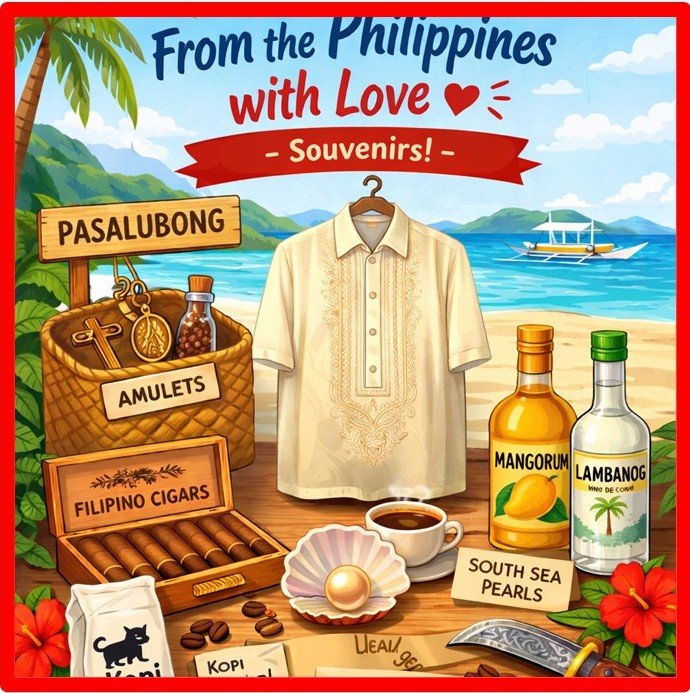
Tourists are back in the Philippines. You can tell from the souvenir shops – business is brisk, and suitcases are swelling with gifts. Alongside the usual trinkets, travelers can also pack a few more… distinctively “only in the Philippines” souvenirs.
Like anywhere else, people flying out of the country tend to grab last-minute gifts at airport duty-free shops, although ’duty-free’ here doesn’t necessarily mean cheaper than regular stores. At international airports, prices can be… optimistic.
But if fridge magnets and mango candies don’t quite cut it, the Philippines offers souvenirs infused with that signature mix of magical realism and everyday absurdity that makes the country what it is. If you want to take a small piece of that home with you, here are a few more unconventional options:
- Amulets
Even today, deep in the countryside and on more remote islands, you’ll find mediums, fortune tellers, and spiritual healers – performance artists of the unseen world – whose services are worth experiencing whether you believe in them or not.
These folk mystics also sell an assortment of talismans and amulets designed to protect you from whatever might be troubling your soul – bad luck, evil spirits, your in-laws, you name it. Along with the amulet, you get a dose of good fortune and, more importantly, a story that will carry you through several dinner parties back home.
- Cigars
For cigar lovers, there’s a wide selection to take home. Filipino cigars may not rank as highly as their Caribbean cousins among connoisseurs. They offer good value for the price and make you briefly question your loyalty to Cuban cigars.
They tend to be light in both color and flavor, with a pleasantly aromatic profile resulting in a smooth, enjoyable experience. Well-known local brands include Flor Isla, Calixto Lopez, Tabacalera Isabela, Independencia 1898, Alhambra, and Flor de Filipinas. The flagship of local premium cigars is Juan Urquijo.
- Instruments of Persuasion
For those interested in self-defense – or more creative interpretations of conflict resolution – there are souvenir shops run by people with firsthand experience in such practices.
Prison workshop stores offer a curious range of handcrafted items that were originally designed to harm others but are now repurposed as decorative keepsakes. From intricately engraved brass knuckles to various self-defense tools, the selection is… memorable.
On the outskirts of Puerto Princesa in Palawan, the Iwahig Penal Colony’s open prison shop even sells beautifully carved hardwood versions of these items. They’re perfect if you want your souvenirs to suggest, “I value craftsmanship,” while also hinting at a touch of plausible deniability.
- Barong Tagalog Shirts
For men who appreciate individuality and natural materials, a Barong Tagalog formal shirt makes an excellent addition to your suitcase.
These shirts are handwoven and embroidered from fibers extracted from pineapple leaves, known as piña, creating a translucent fabric with a subtle sheen and warm golden hue. Piña is the most prized material for barong shirts due to its quality and limited production – a single weaver can produce about 10 meters of high-quality fabric per month.
It’s the kind of garment that quietly says, “I have taste,” while loudly adding, “Yes, this is made from a fruit.”
- Mango Rum
A few decades ago, one of the Philippines’ oldest distilleries, Destileria Limtuaco & Co., had a moment of inspiration: why not combine two excellent things – local sugarcane rum and sweet Philippine mangoes?
The result was mango rum, initially marketed in an eye-catching aluminum cylinder that made it look as though it might contain either fine liquor or classified documents. Rising aluminum prices eventually ended that packaging era, but with a bit of luck, you can still find bottles in their original packaging in liquor stores in larger cities.
- Lambanog
Lambanog, also known as coconut vine, is a traditional distilled spirit made from fermented coconut sap (tuba). After at least two days of fermentation, the result is distilled into something that doesn’t just warm your soul – but rearranges it entirely – and makes you question your life choices. After one distillation, the alcohol content sits around 40–45%. After a second round, it can reach around 60%.
It’s usually consumed straight, though it can also be infused with raisins, mango, pineapple, or whatever happens to be on hand. Traditionally homemade, lambanog is now available in more refined, commercially produced versions from distilleries such as like Mallari, Buncayo, and Capistrano.
- South Sea Pearls
If you know people who can be won over with jewelry, it’s always wise to leave room in your luggage for a bit of beautiful excess – like South Sea pearls. The finest pearls in the Philippines come from southern Palawan, which also gave the world the famous Pearl of Allah (also known as the Pearl of Lao Tzu).
A pearl’s value increases with its roundness and the depth of its golden hue. The rarest and most expensive are perfectly round pearls with a deep golden hue. That said, genuine, high-quality South Sea pearls can still be found in jewelry stores in shopping malls at prices that won’t require selling a kidney (starting at around €100 per piece).
- Kopi Luwak Coffee
If regular instant coffee tastes like shit, the Philippines offers something that takes that concept literally. Kopi Luwak is made from coffee beans that have been eaten and excreted by a civet cat, acquiring their distinctive flavor along the way. Originally from Indonesia, this coffee is prized for both its rarity and its unusual production process.
It’s available in specialty coffee shops catering to those who appreciate not just good coffee, but a good story to go with it.
Life’s Finer Moments
These days, you need to be extra careful when bringing home animal-based “snacks.” Otherwise, you might end up as I did on one particular trip to Finland.
I grabbed my suitcase from the carousel at Helsinki Airport and confidently headed toward customs. The mood shifted rapidly from routine to existential dread when a customs dog wandering among arriving passengers suddenly became very interested in my luggage.
As fellow travelers slowed down just enough to enjoy the unfolding tragedy, a customs officer asked me to step aside while the dog enthusiastically pawed at my bag. Then, two serious-looking officers were called over as witnesses. The theme music from the film Midnight Express began playing in my head at full volume.
When I opened the suitcase, the dog triumphantly unearthed two bags of chicharrón – crispy pork rinds, which I had brought as gifts for Filipino friends living in Finland – buried under my dirty laundry like the world’s least dignified smuggling operation.
The officers examined the bags with professional curiosity before calmly explaining that the dog was trained specifically to detect animal-based products. I did what any reasonable person would do: I claimed I had no idea the “chips” contained animal products.
Miraculously, the officers settled on confiscating the deep-fried evidence. My future, which moments earlier had looked like a Scandinavian prison drama, suddenly brightened considerably.
More on the topic:
The Philippines as a Tourist Destination (part 1)
