Toward the end of World War II, Japanese soldiers are said to have hidden a vast treasure in the Philippines — one President Ferdinand Marcos allegedly spent years searching for. Many believe he didn’t just search for it, but actually found it.
Filipinos are obsessed with buried treasure to such an extent that it has become part of the nation’s collective psyche. Even in small, out-of-the-way villages, you’ll find people who have heard stories about hidden loot buried somewhere nearby.
They often claim to possess “inherited knowledge” of where these treasure caches lie. The problem, however, is that they also believe the treasure is guarded by a bantay-ginto – a long-fanged spirit protector with a human soul.
Many swear they’ve seen these bantay-ginto, creatures supposedly worn down by their endless night shifts, occasionally taking the form of a bat or a bird just to stretch their wings and circle the treasure site. These spirits are considered dangerous, as they are said to try to swap souls with unsuspecting passersby – especially those foolish enough to go looking for treasure.
Hunters of Treasure That Never Was
The Philippines is, without question, an archaeologically rich and fascinating place. But let’s be honest – who gets excited about soot-blackened clay pots when every other conversation hints at gold bars buried in the jungle or stashed in some nearby cave?
For Filipinos, stories about buried treasure don’t point only to material wealth. They also gesture toward a past that existed before foreign rulers showed up with flags, guns, and administrative paperwork. These stories are fragments of an undocumented pre-colonial history – a looted and vanished era – that still tugs at the national subconscious.
Tales of hidden treasure go back centuries. The details change depending on who’s telling the story and how much rum is involved, but one element stays constant: some outside power or passing figure has left something valuable behind in the Philippines. While “hidden treasure” may sound like a pile of gold coins, the metaphor stretches further – it also hints at layers of cultural influence left behind by centuries of contact, trade, and conquest.
Folklore speaks of pre-colonial wealth hidden “somewhere out there.” Arab, Indian, and Chinese traders are said to have buried their own riches across the archipelago. The Spanish shipped gold and silver across oceans in their galleons to distant colonies. The Americans filled bank vaults with silver dollars. But it was the Japanese occupiers who planted the seeds of a story so grand it would win the Oscar for Best Treasure Tale.
The Fever for Hidden Gold
During World War II, the Japanese army seized the wealth of state banks in the territories it conquered and looted private property with industrial efficiency. They amassed staggering quantities of cash, gold, silver, gemstones, pearls – basically anything that could glitter, jingle, or be melted down and counted.
The loot was first gathered in Singapore and later transported to the Philippines. During their occupation, the Japanese continued collecting valuables. They took control of the Benguet gold mines, for instance, and confiscated whatever General Douglas MacArthur and President Manuel Quezon had left behind in the vaults of the national bank.
In 1945, MacArthur made good on his famous “I shall return” promise and fought his way back to Manila. As it became increasingly clear that Japan would lose the war, its military leadership made a strategic decision: other areas of Southeast Asia could be abandoned, but the Philippines would be held for as long as possible. At the time, General Tomoyuki Yamashita was in Manila organizing the city’s defense.
As the war in the Philippines drew to a close, the Japanese decided to hide the wealth they had collected across Asia in various locations around the island of Luzon. American warships and aircraft were considered too great a threat to risk transporting the treasure back to Japan or Taiwan.
The Japanese forces in Manila were effectively fighting a defensive delaying campaign – buying time so that selected units could dig pits and tunnels in various locations across Luzon. General Yamashita himself did not personally hide the treasure, but the men who did were under his command.
The hiding places were carefully designed and equipped with elaborate layers of deception and security: fake maps were drawn, ingenious traps were designed, decoy tunnels were dug, and the sites were rigged with mines and even poison gas canisters.
After Japan’s surrender, Yamashita was charged with war crimes committed by the troops under his command during the occupation of the Philippines. In a controversial trial, he was found guilty of the atrocities carried out by his forces, sentenced to death, and executed by hanging in February 1946.
The Man with the Golden Touch
Many Filipinos believe that Ferdinand Marcos managed to get his hands on part of the Japanese war loot already being whispered about as Yamashita’s treasure. By the time he entered politics, Marcos was known as a wealthy businessman – though the origins of that wealth were never clearly explained.
For years, rumors had circulated in Manila that Marcos had leveraged his connections with Japanese contacts and somehow obtained information about the locations of some of Yamashita’s hidden caches. In a country where gossip travels faster than official statements, that was more than enough to keep the story alive.
The rumors gained fresh momentum when a gold refinery was established in Manila. The official explanation was perfectly reasonable: to process gold from the Benguet mines domestically. The unofficial version – far more entertaining and therefore far more popular – suggested the refinery was needed so Marcos could melt down Japanese gold into an untraceable form and quietly distribute it into Swiss bank vaults, where money goes to enjoy a long, anonymous retirement.
There is, of course, a sizable camp that sees the entire Yamashita treasure story as an elaborate smokescreen. According to this view, Marcos used the myth to distract from the far less romantic reality: his fortune was built on shady deals, clever manipulation, and postwar opportunism dressed up as entrepreneurship. In this telling, the treasure never existed – only the narrative did, carefully planted and left to grow like a rumor that waters itself.
Meanwhile, Imelda Marcos continues to insist – with her trademark unwavering conviction – on her husband’s brilliance as a precious metal trader: “My husband sold part of the remaining Yamashita treasure during a short visit to the United States. He didn’t become rich from that deal, but it taught him how to trade in precious metals.”
The Apparition of the Golden Buddha
In 1988, the Yamashita treasure story got a fresh shot of adrenaline when Filipino treasure hunter Rogelio Roxas filed a lawsuit in the United States against the Marcos couple. This new twist completely transformed the story. Speculation about whether Yamashita’s treasure had anything to do with Ferdinand Marcos’s wealth was no longer idle gossip; now it came with court documents attached.
According to Roxas, his story began in 1961, when he met a Filipino man who had served as General Tomoyuki Yamashita’s interpreter during the war. The man claimed that the most valuable treasures had been buried near Baguio, a mountain city in the northern Philippines. He even provided hints – never a full map, of course, just enough to keep hope alive while keeping logic at bay.
In 1971, Roxas assembled a team to go treasure hunting. He secured an official permit for excavation from a local judge, Pio Marcos – who, in a plot twist nobody found suspicious at the time, happened to be a cousin of President Marcos.
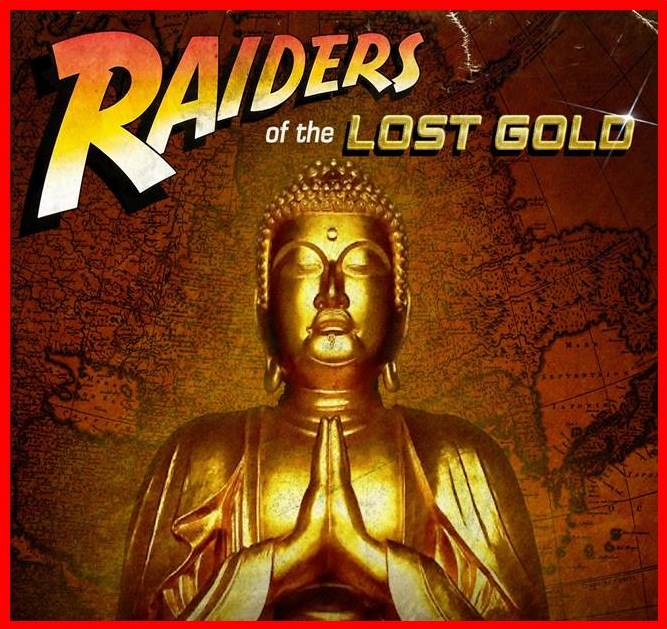
Roxas claimed that on January 24, 1971, his group discovered a sealed chamber near Baguio. Inside were rifles, bayonets, samurai swords, radios – and a skeleton dressed in a Japanese military uniform, as if the set designer had gone all in on authenticity. According to Roxas, the chamber also contained a three-foot-tall golden Buddha statue and wooden crates filled with gold bars.
He said he took the Buddha statue and one crate containing 24 gold bars, then reburied the entrance because he lacked the means to transport the rest. Logistics turned out to be the real villain of the story.
Roxas never weighed the statue but estimated its weight at around 2,200 pounds – a figure that sounds less like a measurement and more like optimism in numeric form. He instructed his team to move the statue and gold bars to his home. He also tried twice to report the discovery to Judge Marcos, but the judge was suddenly very hard to reach.
The Golden Buddha Disappears
In the following weeks, Roxas sold seven of the gold bars and began looking for a buyer for the Buddha statue. According to him, one potential buyer drilled a small hole beneath the statue’s arm and analyzed the metal, concluding it was made of 22-karat gold. Another buyer tested it with nitric acid and arrived at a similar conclusion: over 20 karats. In other words, not a souvenir.
Then, one night in June 1971, armed men broke into Roxas’s home and confiscated the Buddha statue and the remaining gold bars. As a bonus, they also took jewelry, cash, and other valuables from the family – because consistency matters.
The next day, Roxas reported the incident to the local police and received what could best be described as a professional shrug. He eventually managed to meet Judge Pio Marcos, who informed him – without apparent irony – that nothing could be done, as the president wanted the confiscated items for himself.
Roxas later claimed that his persistent and very public campaign to recover the golden Buddha and the gold bars earned him more than just attention. According to him, the president responded with threats, had him beaten, and arranged a year of imprisonment for him.
When Justice Wins, Someone Still Loses
After the Marcos family fled the presidential palace in 1986 and settled into exile in a Honolulu bungalow, Rogelio Roxas kept his crusade alive. In 1988, he established a U.S.-based company called Golden Buddha Corporation and, with the help of skilled lawyers, set out to claim ownership of the now-legendary golden statue.
On behalf of the company, he filed a lawsuit in a Hawaii state court against Ferdinand Marcos and Imelda Marcos, seeking recognition of ownership as well as damages for human rights violations he claimed to have suffered.
Roxas died on the eve of the trial, but not before giving a sworn written testimony, which was later used as evidence in court. In 1996, the court awarded Golden Buddha Corporation, owned by Roxas’s heirs, a staggering $22 billion in damages. With interest and penalties, the sum ballooned to almost $40.5 billion.
Imelda Marcos’s legal team appealed the ruling to the state supreme court, which in 1998 confirmed that there was sufficient evidence to support the earlier finding: Roxas had indeed found the treasure, and Marcos had taken it from him.
However, the court overturned the massive damages award, ruling that the $22 billion figure was excessive given the lack of solid evidence regarding the quantity and quality of the gold. A new hearing was ordered to determine the value of the golden Buddha and 17 gold bars – apparently, even legendary treasure must eventually submit to accounting.
In the end, the court ordered the estate of Ferdinand Marcos and Imelda Marcos to pay $13,275,848.37 to Golden Buddha Corporation for the theft of the statue and gold bars, along with $6 million to Roxas’s heirs for human rights violations.
But since U.S. courts have no jurisdiction in the Philippines – and since none of the Marcos assets in the United States could be successfully liquidated – the ruling remained, in practice, a moral victory.
The Treasure and the Story
To this day, there is no definitive proof that Ferdinand Marcos or Rogelio Roxas ever found Yamashita’s treasure – if such a thing ever existed in the first place. And if they did find something, was it merely a fragment of a much larger hoard?
Where is the golden Buddha now – or was there ever one to begin with? Why did Roxas take the exact location of the treasure chamber with him to the grave? And what happened to all the Japanese soldiers who supposedly hid the treasure, or the Filipino workers who helped dig it up?
From a strictly logical point of view, it would make sense that the Japanese gradually shipped their war loot back home as they accumulated it. But that’s a deeply unsatisfying conclusion for treasure hunters and storytellers alike – about as exciting as finding out the pirate retired early and invested wisely.
Toward the end of the war, Japan evacuated its highest-ranking officers from the Philippines by submarine to avoid Allied ships and bombers. One might assume it would have crossed their minds to take at least the most valuable loot along for the ride.
Or was it somehow more reasonable to assign a large group of men to bury vast riches in the ground and leave them behind on distant islands soon to be occupied by the enemy? Did they expect to return after the war – perhaps short on cash – and casually dig up their fortune on foreign soil?
And when the Japanese later read in newspapers about thousands of treasure hunters scouring the islands, did it only then occur to them that someone else might stumble upon their caches?
But logic, human behavior, and sensible motives tend to lose their voices when a good story takes over. As long as there’s even the faintest chance that Yamashita’s treasure might be real, the story will continue to live on – quietly provoking curiosity and feeding the imagination.
More on the topic:
Death March – The Passion Play of Easter
