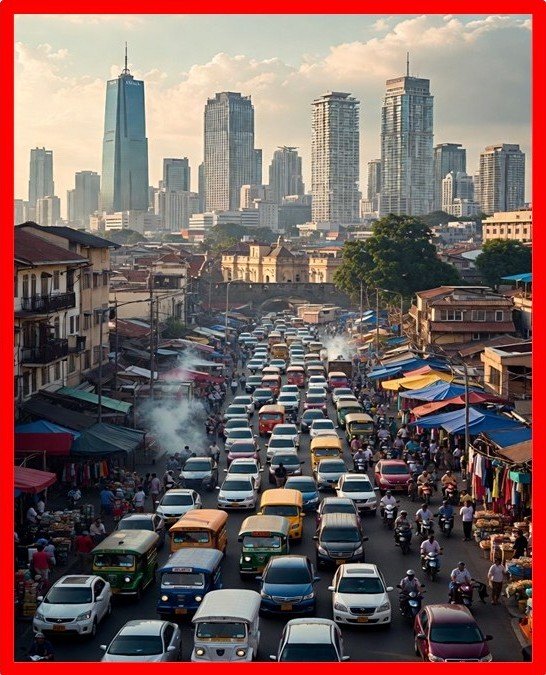
Manila is basically a self-improvement program disguised as a city: the endless gridlock builds your patience, natural disasters sharpen your risk assessment skills, karaoke doubles as therapy, and the air-conditioned malls keep your head cool when everything else overheats.
When foreigners dream of the Philippines, they picture white sand beaches, swaying coconut palms, turquoise water, and Instagram-perfect tropical escapes. In reality, though, the heart of the country beats far away from the sunsets of Boracay or the hidden lagoons of Palawan.
If you really want to understand the Philippines, it’s not enough to admire tourist postcards or settle into a sleepy provincial town where everyone knows your business and life hasn’t changed much since the 1970s. If you want to see the country in all its contradictions, Manila gives you a front-row seat.
A Kingdom Within a Kingdom
Metro Manila, officially known as the National Capital Region (NCR), is one of the most sprawling urban areas in the world. The official population is around 14 million, but the wider Manila metropolitan area is home to well over 20 million people. In this country, all roads lead to Manila – and traffic stalls on all of them.
The city is built on contradictions that don’t even try to make sense. Areas like Makati and Bonifacio Global City (BGC) shine like a glimpse into a high-tech future: glass skyscrapers, rooftop bars, electric scooters, and artisanal coffee that costs more than a full family meal in the provinces.
Then, just a few blocks away, everything shifts. Rats scurry through the gutters, and barefoot children weave between stalled cars like it’s second nature. Manila isn’t one city – it’s multiple realities layered together, constantly colliding.
The Cradle of History and Culture
Manila is a chaotic mix of historical influences that no one ever bothered to organize. The Spanish, the Americans, and the Japanese all left their mark on the architecture, the culture, and the way things work – and sometimes don’t.
Ferdinand Magellan reached these islands in 1521, but real colonial rule began in the 1560s under Miguel López de Legazpi. The Spanish built forts, cathedrals, and centers of power, where fear and faith lived side by side.
At the turn of the 20th century, the Americans introduced modern urban planning, wide boulevards, and the promise of a more structured system. Along with that came basketball, Hollywood, and the English language. Filipinos learned to think globally while holding on to a strong local identity.
The Japanese occupation taught the city how to hide, survive, and rebuild. From the destruction of World War II through martial law and the EDSA People Power Revolution… Manila became a place where history isn’t just something that happened – it’s something you live with.
There are plenty of museums – and honestly, the air conditioning alone is reason enough to visit – but Manila’s real history isn’t behind glass. It’s out in the streets, in the buildings, and in the people. Look closely and you’ll notice something: Manila isn’t cold. It’s chaotic, but warm. If you fall, someone will pick you up. If you’re late, someone says, “It’s okay,” and actually means it.
A City of Impossible Possibilities
Manila has an energy you just can’t replicate in the provinces or on quieter islands. This is where dreams are built, broken, and built again. The city doesn’t sleep – it simply doesn’t have time.
For foreign entrepreneurs, Metro Manila is a high-stakes playground. Millions of potential customers are within reach, and an English-speaking workforce keeps things running smoothly. This is where money moves, even when traffic doesn’t.
But the real secret to surviving chaos is realizing that nothing works in isolation. Everything runs on connections: family, friends, and friends of friends. It’s not what you know, it’s who you know. At first, that can feel frustrating. Then you realize it’s just human nature.
Everything Is Close, Too Close
Manila is the gateway to everything. Ninoy Aquino International Airport (NAIA) connects you to the rest of Asia, and domestic flights can take you anywhere in the archipelago. On paper, everything is close. In reality, a two-mile trip can take an hour. On a good day, it might take ten minutes. Manila teaches you Einstein’s theory of relativity better than any textbook ever could.
While restaurants in other parts of the country might close before you’ve even decided what to order, Manila runs 24/7. Bars, karaoke joints, and clubs make sure no one has to go to bed early – or go to bed at all.
And then there are the malls. In Manila, they’re not just places to shop – they’re a way of life: air-conditioned refuges from the heat, the rain, and the chaos outside. People eat there, meet there, watch movies there, and sometimes even go to church there. Yes, many malls even have a chapel.
When Chaos Becomes Home
The first thing Manila takes from you is the illusion of control. Then it shows you who you really are. How patient are you – really? How flexible? You can’t fake being calm here. You are either calm or you learn to be.
Manila is like that friend who is always late, but still the one you most want to see. It frustrates you, tests you, and occasionally drives you crazy, but somehow you don’t want to leave. It’s addictive.
I once showed up hours late to a meeting, and the person just smiled and said, “It’s Manila, don’t worry.” Where else is lateness not just tolerated, but practically expected? Manila forces you to relax – whether you like it or not.
The Foreigner’s Experience
There’s a reason many foreigners gravitate toward Metro Manila. The jobs, the hospitals, the schools, and the business opportunities are all here.
You might notice that many expats keep a surprisingly low profile online. Life in the city is so intense that social media starts to feel less necessary. When things are constantly happening around you, you don’t feel the need to scroll as much.
There are also enough foreigners that you can find your own community – not just among fellow citizens, but among people who share your interests. Elsewhere in the country, expats are so spread out that running into one feels like a rare event.
Why Manila?
A lot of people hate Manila. And honestly, that’s completely fair. But the people who stay don’t stay because it’s easy.
People often ask me why I don’t just live in Palawan or on some quiet, untouched beach. The answer is simple: there, I’d always be a tourist. In Manila, I’m part of everyday life.
At some point, you stop trying to make sense of Manila – and something shifts. The city stops feeling like a battle and starts feeling like an experience. That’s when you realize what your brain has been telling you all along: for me, Manila offers the combination of infrastructure, services, and opportunities that makes long-term life in the Philippines practical.
And one day, when you find yourself somewhere quiet, organized, and perfectly functional – in some other country – you’ll notice something strange. You miss it.
Not the noise. Not the pollution. Not even the traffic. You miss that feeling that anything could happen – even if nothing is certain. That’s when you know Manila has worked its way into you.
On the same topic: Cebu City – The Heart of the Philippines
