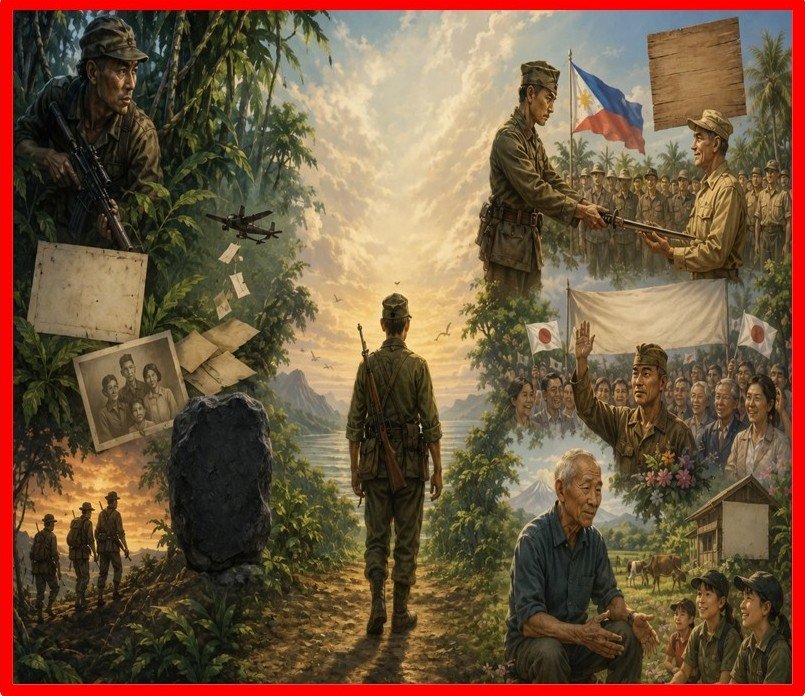
World War II ended in 1945 – except for one man. Japanese Lieutenant Hiroo Onoda spent nearly thirty years hiding in the jungles of the Philippines, convinced the war had not yet ended.
Onoda’s story is not merely a tale of extraordinary endurance. It is also a cautionary lesson about how dangerous blind obedience and ideological fanaticism can become. He survived the merciless jungle conditions but gradually lost his grip on reality.
The war he fought in the mountains and rainforests of Lubang Island continued inside his mind long after the surrender. To some, Onoda became a hero. To others, he was a feared menace. But to everyone, he remained an example of what human beings are capable of when they surrender themselves completely to a cause.
Demolition Man
Onoda enlisted in the Imperial Japanese Army at the age of twenty. After officer training, he was selected for the army intelligence academy, where he studied unconventional warfare, guerrilla tactics, and espionage.
In December 1944, Onoda was sent to Lubang Island in the Philippines to take command of the Japanese forces stationed there. Located off Manila Bay, Lubang is a small island approximately 26 kilometers long and less than 10 kilometers wide, covered in dense rainforest, steep mountains, and tangled valleys. Although relatively close to the capital city of Manila, the island remains difficult to reach today.
Onoda’s unit was ordered to destroy the island’s small airstrip and harbor facilities. They were also given one strict command: surrendering and committing suicide were forbidden under any circumstances. Onoda followed those orders far more literally than his superiors had imagined.
The mission was never completed. In February 1945, American and Filipino forces captured the island before Onoda’s unit could carry out its objective. Onoda and his three remaining men fled into Lubang’s mountainous interior and swore to continue fighting from the jungle.
Japan surrendered on August 15, 1945, but Lieutenant Hiroo Onoda and his men refused to lay down their arms. They believed the surrender was nothing more than a temporary tactical retreat by the Japanese military. Together with Corporal Shoichi Shimada, Private Kinshichi Kozuka, and Private Yuichi Akatsu, the group prepared for a prolonged guerrilla war behind enemy lines. Onoda himself was only twenty-three years old at the time.
Cliffhanger
Thus began a guerrilla war that would continue for nearly three decades against Lubang’s civilians, police, military forces, and search patrols. Over time, the island’s farmers learned to live with the constant possibility that armed Japanese soldiers might suddenly emerge from the mountains to steal cattle, burn rice stores, torch homes, or shoot anyone unlucky enough to cross their path. Historians estimate that Onoda’s group killed at least thirty Filipino soldiers during various clashes.
In October 1945, the group discovered leaflets which announced the war had ended on August 15 and urged them to come down from the mountains. The men dismissed them as Allied propaganda. In their minds, if the war had truly ended, the authorities would not be hunting them.
A few months later, aircraft flew over the island dropping additional leaflets containing a surrender order signed by General Tomoyuki Yamashita, commander of Japan’s 14th Area Army. Onoda and his men rejected that message as well.
Later, search teams dropped personal letters, family photographs, and emotional appeals from the soldiers’ relatives into the rainforests of Lubang. The soldiers found the items but interpreted them as part of an elaborate Allied trap designed to lure them into surrender.
The men survived on small portions of rice, coconuts, jungle fruit, and meat obtained by slaughtering local cattle and taking chickens from villagers. They slept in makeshift shelters built from branches and leaves while enduring tropical heat, endless humidity, monsoon rains, and swarms of malaria-carrying mosquitoes.
After nearly five years, Yuichi Akatsu finally broke under the misery of jungle life and the constant fear of death. In 1950, he abandoned the group, surrendered to the Philippine Army, and returned to Japan. Akatsu informed authorities that his three former comrades still believed the war was ongoing.
In 1954, Shoichi Shimada was killed during a firefight with a military search patrol. Kinshichi Kozuka remained with Onoda for another eighteen years before he too was shot and killed in 1972. Kozuka and Onoda had been burning rice storage buildings in a coastal village, which triggered yet another armed confrontation with the police.
Escape Plan
Over the years, the story of a lone Japanese soldier still fighting on a remote Philippine island became a national obsession in Japan. Among those fascinated by the legend was a young adventurer named Norio Suzuki, who decided to travel to Lubang and search for Onoda himself.
Suzuki found Onoda in February 1974. Onoda explained that he would never surrender unless he received direct orders from the same officer who had originally assigned him to the mission. Suzuki returned to Japan carrying photographs of himself with Onoda as proof that the legendary holdout soldier was still alive.
The Japanese government eventually located Onoda’s former commanding officer, Major Yoshimi Taniguchi, who was by then working as a bookseller. Taniguchi was flown to Lubang Island to deliver an official order to end the mission and command Onoda to surrender.
Suzuki and Taniguchi met Onoda at a prearranged location on March 9, 1974. Major Taniguchi formally read the order declaring that all combat operations were to cease immediately. After hearing the command, Onoda finally spoke: “I have carried out my duty.” The following day, he surrendered to Philippine authorities in a ceremony overseen by Air Force Major General Jose Rancudo.
The official surrender ceremony took place at the Presidential Palace on March 11. Onoda appeared wearing his nearly thirty-year-old Imperial Army uniform, astonishingly well preserved despite decades in the jungle. During the ceremony, he handed his sword to President Ferdinand Marcos, who immediately returned it as a gesture of respect for Onoda’s extraordinary loyalty and military discipline.
Marcos granted Onoda a pardon for crimes committed on the island, because he had genuinely believed the war was still ongoing. Afterward, Hiroo Onoda returned to Japan, where he was welcomed home as a national hero.
Onoda himself, however, felt deeply alienated by modern Japan. In his eyes, the country had become a mere shadow of the empire he had defended in the jungles of Lubang. He continued to believe that if more Japanese soldiers had been willing to fight to the end as he had, Japan might have won the war.
Later that same year, on December 18, 1974, Taiwanese-born Japanese soldier Teruo Nakamura surrendered on Morotai Island in Indonesia. Although Nakamura was technically the last known Japanese wartime holdout to surrender, he never achieved the same heroic status or public attention as Onoda. Part of the reason was that his story was never romanticized in the same way, but his Taiwanese background also played a role.
Last Blood
Soon after returning home, Onoda published his autobiography, No Surrender: My Thirty-Year War, in which he described how he maintained his belief that the war was ongoing
and how he survived the brutal realities of the rainforest. At the same time, his disappointment with modern Japan deepened, and he struggled under the weight of his newfound fame. In April 1975, he left Japan and followed his brother to Brazil.
In Brazil, Onoda married and eventually became a successful and wealthy cattle rancher. In 1984, he returned to Japan and founded a wilderness survival school for young people called Onoda Shizen Juku (Onoda Nature School), which later opened training centers across the country.
In May 1996, Onoda visited Lubang Island, where he had hidden and waged war for twenty-nine years. Although his group had killed several local Filipino residents during those years, he was welcomed back as an honored guest. In the predominantly Catholic culture of the Philippines, many viewed his prolonged suffering as a form of symbolic atonement for his sins.
Hiroo Onoda died at his home in Japan on January 16, 2014, at the age of ninety-one.
Further reading:
