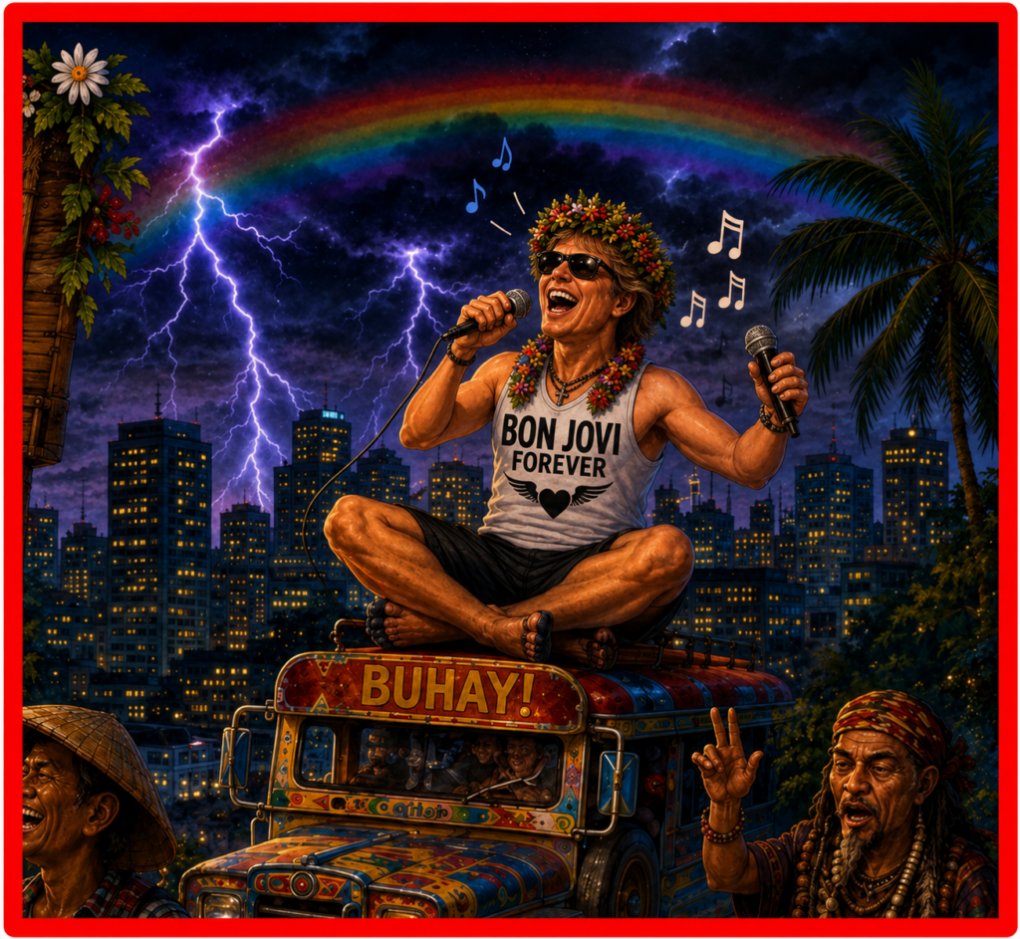
There are countries where everything follows logic. And then there’s the Philippines. Here, logic doesn’t exactly disappear – it simply finds a different job and starts working under a completely different set of rules. The longer you live here, the more often you encounter what I like to call the Filipino paradox.
The Filipino paradox is the curious ability of two completely contradictory things to exist without anyone finding them contradictory at all. Locals don’t feel the need to explain it because, to them, there’s nothing to explain. Visitors, on the other hand, spend their first few weeks wondering what on earth is going on. Eventually, they stop trying to figure everything out – and that’s precisely when life in the Philippines begins to make an unexpected kind of sense.
The Filipino paradox isn’t a glitch in the system; it is the system. It’s an invisible operating manual that Filipinos absorb naturally as children, while foreigners often need years to decipher it. Once you finally understand it, you stop asking, ”Why would anyone do it this way?” Instead, you simply shrug, smile, and say, ”Well… this is the Philippines.”
Here are a few examples of the Filipino paradox in action – things that really shouldn’t exist if the world were governed solely by logic and common sense. Yet they don’t merely exist; they form the very foundation of everyday Filipino life and culture. Nobody questions them. Nobody finds them strange. They simply are.
More Than Just a Ride
Your first encounter with the Filipino paradox usually happens in traffic. In most countries, public transportation is designed to be uniform, practical, and instantly recognizable. The Philippines went in exactly the opposite direction. If a vehicle doesn’t look like it just won a Christmas decoration contest, it’s still waiting for the finishing touches.
The legendary jeepney was born from surplus U.S. military jeeps left behind after World War II. Today, it remains the backbone of public transportation in the Philippines – but it’s also a rolling work of art. Chrome gleams everywhere, neon colors compete for attention, religious icons share space with inspirational slogans, pop stars, and sometimes even the names of an entire extended family. Inside, passengers pass fares from hand to hand until they reach the driver. Nobody seems to count the money or worry whether they’ll get the correct change back. Yet somehow, the money always gets where it needs to go.
A jeepney is much more than a way to get from one place to another – it’s a tiny community on wheels. People chat with strangers, exchange neighborhood news, and somehow make room for one more passenger, even when any foreigner would swear the vehicle had reached full capacity several stops ago. In the Philippines, a jeepney always seems capable of carrying exactly one more person than the laws of physics are willing to allow.
Sweet Spaghetti, Big Love
Once you’ve survived the traffic, it’s time to eat. The unsuspecting traveler walks into a fast-food restaurant and discovers it’s Jollibee – the place where Filipinos will happily tell you the burgers are better than McDonald’s. But the real culture shock doesn’t come with the burger. It arrives with the spaghetti.
Filipino spaghetti looks Italian at first glance, but that’s where the resemblance largely ends. The sauce is sweet, bright red hot dog slices are mixed in, and the whole creation is topped with a generous layer of grated cheddar cheese. The first bite makes you question your life choices. The second leaves you genuinely puzzled. By the third, you catch yourself ordering it again. By the fourth, you begin wondering if Italians might have been taking spaghetti just a little too seriously all these years.
For Filipinos, Jollibee is far more than a fast-food chain – it’s a national institution. Children celebrate birthdays there, and Filipinos living overseas often crave it whenever homesickness strikes. Most visitors walk in out of curiosity, but they leave realizing that Jollibee isn’t simply about food. It’s a taste of the Philippines itself.
Balut and Bon Jovi
If sweet spaghetti wasn’t enough to turn your culinary expectations upside down, the next challenge is balut. It’s a boiled duck egg with an embryo that’s already well on its way to becoming a duck. For locals, it’s an ordinary evening snack. For first-time visitors, it’s more like your own episode of Fear Factor. The funny thing is that nobody actually pressures you to eat it – yet almost everyone eventually does.
As night falls, another familiar sound takes over the streets: the unmistakable cry of the balut vendor – ”Baluuuut!” At the very same time, Frank Sinatra, Celine Dion, or Bon Jovi begins echoing from a nearby house. Not from the original recording, of course, but from a neighbor singing with such fearless confidence that even Jon Bon Jovi himself would put down his microphone
and graciously let the performance continue. In the Philippines, videoke isn’t just a hobby – it’s a way of life. It is a staple of birthdays, weddings, funerals, family reunions, and perfectly ordinary Tuesday nights.
The best part is that nobody expects perfection. What matters is joining in, singing from the heart, and preferably singing loud enough for half the neighborhood to enjoy it. And if someone hands you the microphone, the polite response isn’t to invent an excuse – it’s to grab it and give it your best shot. That’s the moment you realize that, in Filipino culture, shared joy beats flawless performance every single time.
English… Sort Of
One of the most entertaining things about the Philippines is the language. A conversation may begin in Tagalog, switch to English halfway through a sentence, and end back in the local language without anyone even noticing they’ve changed languages. It’s called Taglish, and getting used to it takes a little time. During your first week, it feels like you’re listening to three different conversations at once. A month later, you suddenly realize you understand far more than you ever expected.
Taglish also tells the story of the Philippines itself. More than three centuries of Spanish rule, nearly fifty years under American administration, and dozens of native languages have blended together so naturally that the result is impossible to imitate. At some point, nobody seems to know exactly where English ends, Spanish begins, and Tagalog takes over – and, truth be told, nobody really cares.
For visitors, though, Taglish is a gift. Even if you understand only half of what’s being said, familiar English words keep popping up just often enough to make you think you’re following the conversation. Then, just as you’re congratulating yourself for understanding the whole sentence, it suddenly switches back to Tagalog, and you find yourself smiling and nodding enthusiastically at exactly the wrong moment.
Two Seats Are Plenty for Six
Getting around teaches you the next lesson. To European eyes, a tricycle looks like a motorcycle with a tiny sidecar awkwardly bolted onto it – a vehicle that seems capable of carrying, at most, two reasonably small people and their optimism. To a Filipino, however, the very same machine is perfectly suitable for transporting an entire family, two sacks of rice, a refrigerator, the family dog, and a week’s worth of groceries. Gravity puts up a fight, but optimism wins every time.
Then the driver pulls over to pick up one more passenger. The tourist begins questioning the laws of physics. The locals simply shuffle over a few inches, smile, and assure everyone, ”There’s still plenty of room.” A Filipino tricycle doesn’t obey Euclidean geometry. It follows its own version, where interior space expands in direct proportion to everyone’s willingness to squeeze together.
For many visitors, their first tricycle ride becomes one of those memories they never forget. Your knees are somewhere near your ears, your head bumps the roof every time you hit a pothole, and every oncoming truck feels as if it’s about to brush your shoulder. Yet somehow, you almost always arrive safely. And before long, you catch yourself looking for another tricycle instead of hailing a regular taxi.
Boodle Fight – Dig In
When it’s time to celebrate, diners don’t get individual plates. At a Boodle Fight, a long table is covered with banana leaves and piled high with rice, grilled meats, seafood, and vegetables. Then everyone gathers around and eats with their bare hands from the same feast. The name sounds like a military operation, but the atmosphere feels much more like one big family reunion.
First-timers usually approach a Boodle Fight with a certain amount of hesitation. Where are the plates? The forks? Is someone going to explain the rules? The locals solve the problem in the simplest possible way: they wash their hands, smile, and start eating. Five minutes later, even the most skeptical visitor discovers that eating with your fingers feels surprisingly natural.
A Boodle Fight probably says more about Filipino culture than any ceremonial speech ever could. Sharing one meal from the same table is a reminder that what matters most is making sure no one is left without food – or without company. The name may suggest a fight, but in reality, it’s more like a well-coordinated assault on hunger, where the only weapons are a good appetite and ten nimble fingers.
A Little of Everything… and Just Enough
The real heart of everyday life, however, is the sari-sari store. This tiny family-owned neighborhood shop seems to sell almost everything – but only in exactly the quantity you need at that moment. One egg. One cigarette. One packet of instant coffee. One sachet of shampoo. For millions of Filipinos, that’s more than enough.
But a sari-sari store is much more than a corner shop. It’s the neighborhood’s living room, news desk, microbank, community center, weather station, and occasionally even a relationship counselor. People stop by to catch up on local gossip, borrow a few pesos until payday, and find out who’s getting married, who’s moving away, and who welcomed a new baby this week. If Facebook ever disappeared overnight, many Filipino neighborhoods probably wouldn’t notice much of a difference.
Visitors often wonder why the shelves are packed with hundreds of tiny sachets instead of the large economy packs. The answer is simple: not everyone needs – or can afford – to buy a week’s worth of supplies at once. When people get paid at the end of the day, that’s also when they buy that evening’s coffee, shampoo, instant noodles, or an ice-cold soft drink. Tomorrow can take care of itself. For millions of Filipinos, that’s not just a shopping habit – it’s an economic reality and a way of life.
Somehow… It All Starts to Make Sense
Amid all this, there’s one thing that truly makes the Philippines special: courtesy. The little word po, used to express respect and politeness, slips naturally into conversations, and younger people greet their elders by gently bringing the elder’s hand to their forehead – a traditional gesture of respect known as mano. It’s not a performance put on for tourists. It’s simply part of everyday life.
Perhaps that’s the greatest paradox of the Philippines. The country can feel chaotic, noisy, and, at times, completely impossible to understand. Yet beneath all that, people treat one another with remarkable warmth and kindness. The moment you stop comparing everything to your home country – and accept that not everything has to make perfect sense – something unexpected begins to happen.
There you are, riding in a jeepney. You’re balancing a shopping bag on your lap that, according to the laws of physics, should never have fit in the first place. You’re humming a Bon Jovi song, happily eating sweet spaghetti, answering someone half in English and half in Tagalog, buying a single sachet of instant coffee from the neighborhood sari-sari store, and automatically saying, ”Salamat po,” as you leave.
And that’s the moment you realize the Filipino paradox hasn’t just changed the way you see the Philippines. It has changed the way you see life itself. Because not everything has to make sense. Sometimes, it’s enough that it simply works.
Related reading:
